Rules and informations about games.
This is the multi-page printable view of this section. Click here to print.
Games
Rules of games
- 1: Amazons
- 2: Breakthrough
- 3: Catchup
- 4: Chess
- 5: Conhex
- 6: Oceans 11
- 7: Connect6
- 8: Dots and boxes
- 9: Draughts
- 10: Dvonn
- 11: Backgammon
- 12: EinStein würfelt nicht!
- 13: Fendo
- 14: Four in a row
- 15: Gomoku
- 16: Go
- 17: Golem word game
- 18: Havannah
- 19: Hex
- 20: Line of Action
- 21: Lyngk
- 22: Morelli
- 23: Oski
- 24: Polyomino
- 25: QYPS
- 26: Reversi
- 27: Shogi
- 28: Tumbleweed
- 29: Slither
- 30: Sixfold
- 31: Street soccer
- 32: Twixt
- 33: Tzaar
- 34: WYPS
- 35: XiangQi
1 - Amazons
The Game of the Amazons is a two-player abstract strategy game invented in 1988 by Walter Zamkauskas of Argentina.
Rules
White moves first, and the players alternate moves thereafter. Each move consists of two parts. First, one moves one of one’s own amazons one or more empty squares in a straight line (orthogonally or diagonally), exactly as a queen moves in chess; it may not cross or enter a square occupied by an amazon of either color or an arrow. Second, after moving, the amazon shoots an arrow from its landing square to another square, using another queenlike move. This arrow may travel in any orthogonal or diagonal direction (even backwards along the same path the amazon just traveled, into or across the starting square if desired). An arrow, like an amazon, cannot cross or enter a square where another arrow has landed or an amazon of either color stands. The square where the arrow lands is marked to show that it can no longer be used. The last player to be able to make a move wins. Draws are impossible.
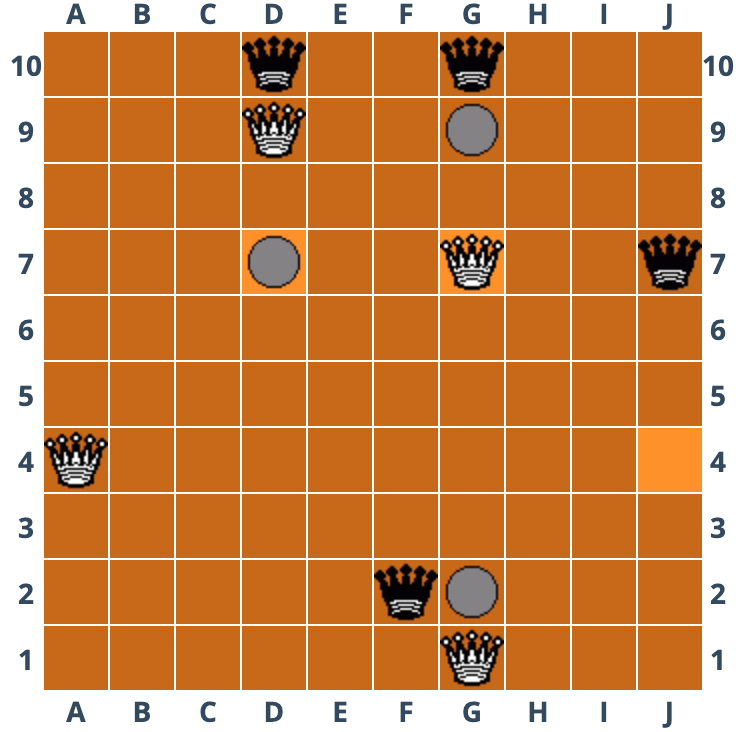
Variants
Two variants are played on LittleGolem. The standard game and Cross Variant, where the starting position is different.
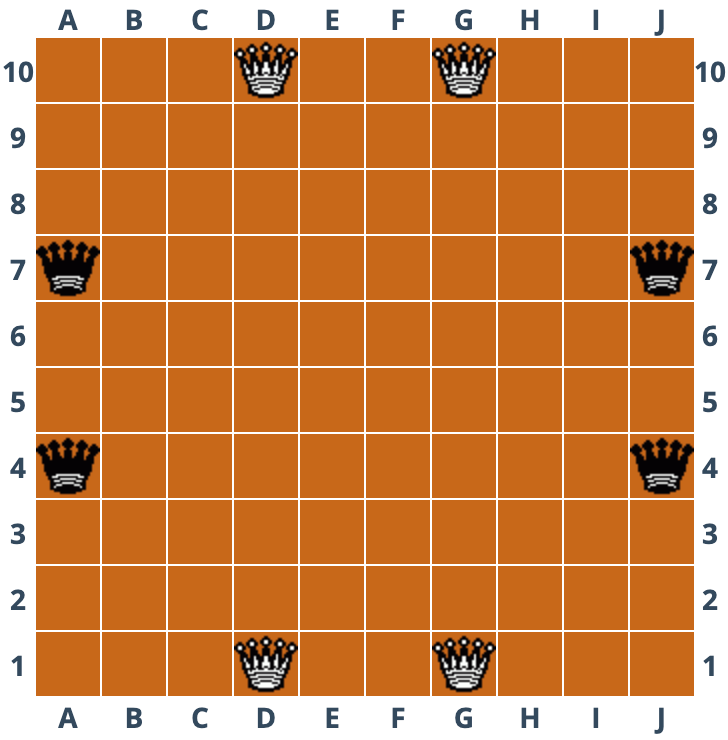
Links
- Wikipedia - Rules, history
- Board Game Geek
2 - Breakthrough
Breakthrough is an abstract strategy board game invented by Dan Troyka in 2000.
Rules
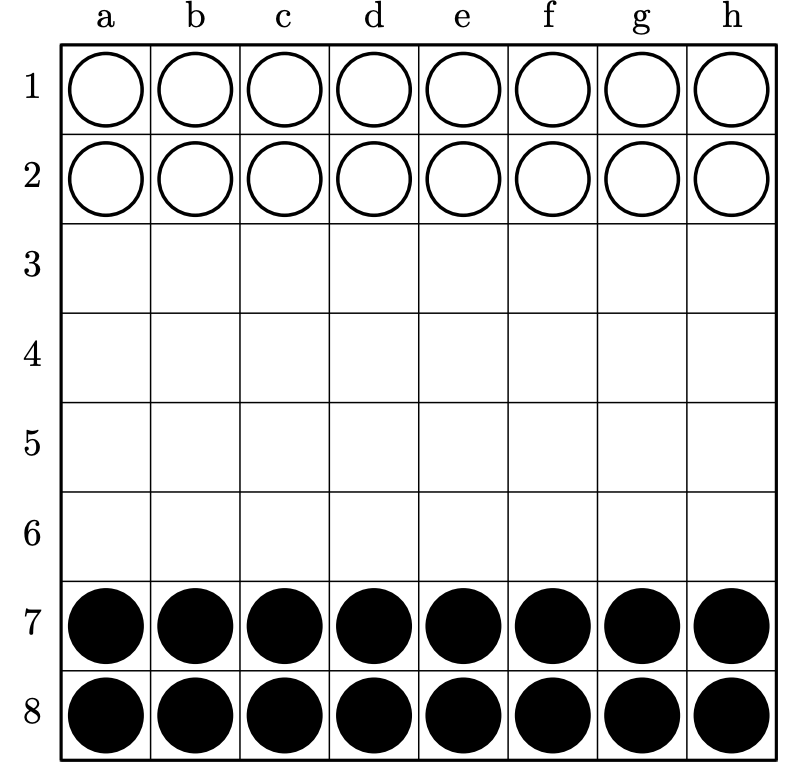
Breakthrough was originally played on a 7×7 board with 14 pieces per player; however, since it won the 2001 8×8 Game Design Competition sponsored by the Abstract Games Magazine and the Strategy Gaming Society, the 8×8 version with 16 pieces per player is considered standard. Advanced players might enjoy the more complex 10×10 version with 30 pieces per player. The standard game starts with the first two rows in front of each player filled with his pieces (see the figure). Players alternate moving one of their own pieces per turn, trying to reach the opposite side of the board. The first player to do so will be declared the winner.
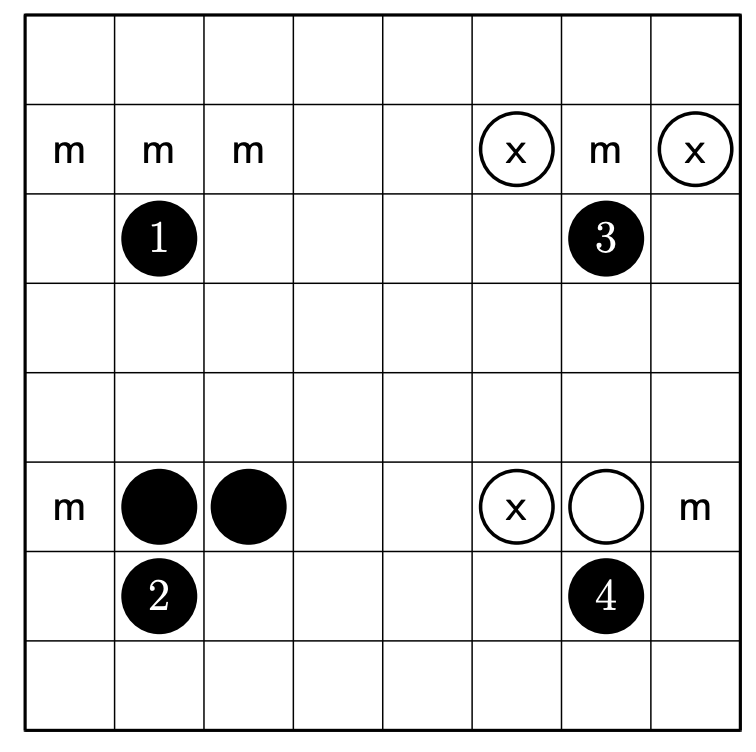
A piece can move forward or diagonally forward to an adjacent empty cell. Alternatively, it can capture an enemy piece diagonally forward (as chess pawns do). Captures are neither compulsory nor can be chained. In the figure, piece 1 can move freely, whereas piece 2 has two of their three possible moves blocked by friendly pieces. Piece 3 can move directly forward or capture any of the enemy pieces, whereas piece 4 can capture or move diagonally but is unable to move forward. Note that White’s pieces move and capture in the opposite direction.
Links
- Basic Introduction - Great indroduction (6 page) to game by Carlos Luna-Mota. (github link)
- Board Game Geek
- Wikipedia
3 - Catchup
Invented by Nick Bentley in 2010
Catchup is a simple abstract game with a devilish dynamic. The goal is to have the largest group of stones on the board when the board is full of stones, but as you get closer to winning, your opponent gets more powerful. Whereas most stone-placement games are about position, Catchup is about timing, position, and the interplay between them.
Definitions:
-
Group – a set of connected, like-colored stones on the board. A single stone is also considered a group.
-
Score - your score is the number of stones contained in your largest group. At the beginning of the game, both players’ scores are set to 1
Rules:
-
One player owns the white stones and the other owns the black. White begins by placing 1 stone on any empty space.
-
From then on, starting with black, players take turns. On your turn, you may place 1 or 2 stones, or up to 3 if your opponent’s score increased on their last turn and is, at the beginning of your turn, greater than or equal to your score.
-
After taking your turn, if your score has changed, move your pawn to the corresponding spot on the scoring track.
-
The game ends when the board is full. The player with the largest group wins. If the players’ largest groups are the same size, compare their second-largest groups, and so on, until you come to a pair which aren’t the same size. Whoever owns the larger of the two wins.
Variants
Three variants with different board are played on Little Golem.
Standard game on size 5
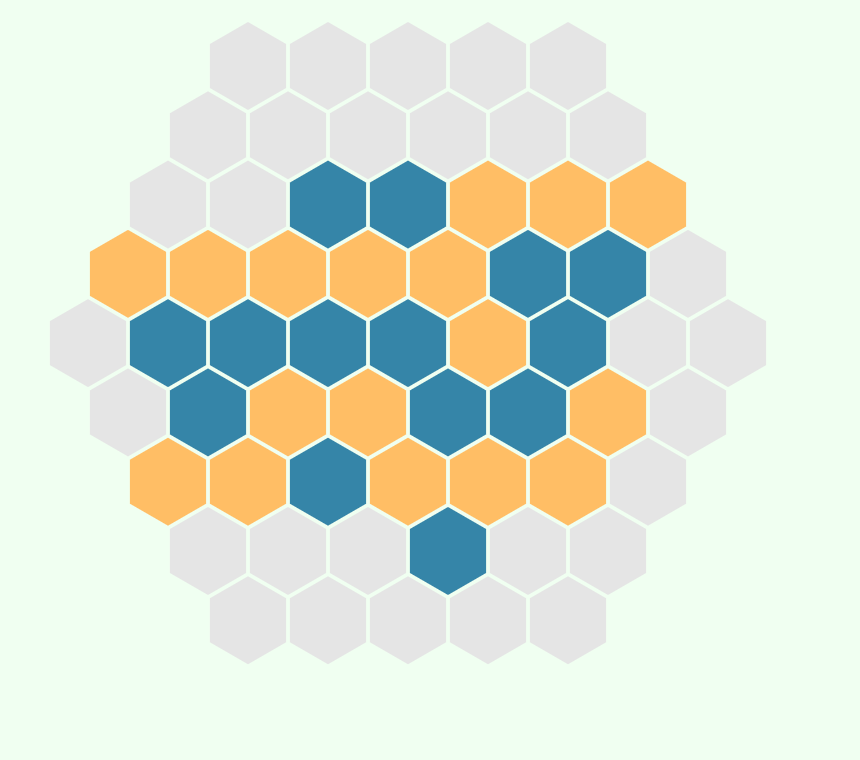
Game on random board
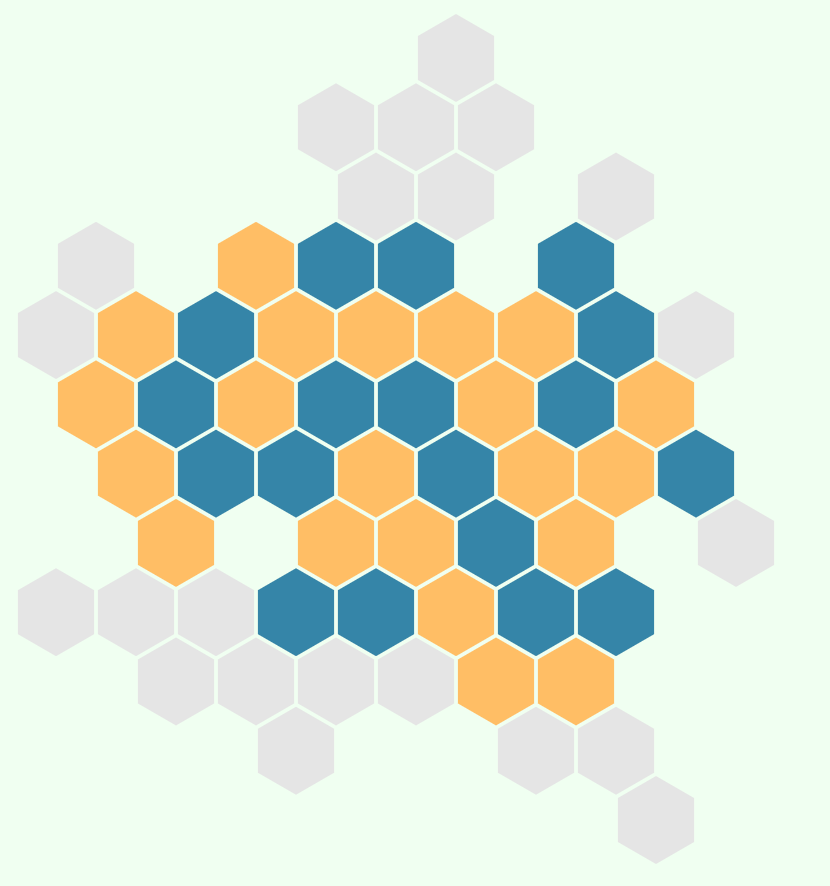
Game on on size 7
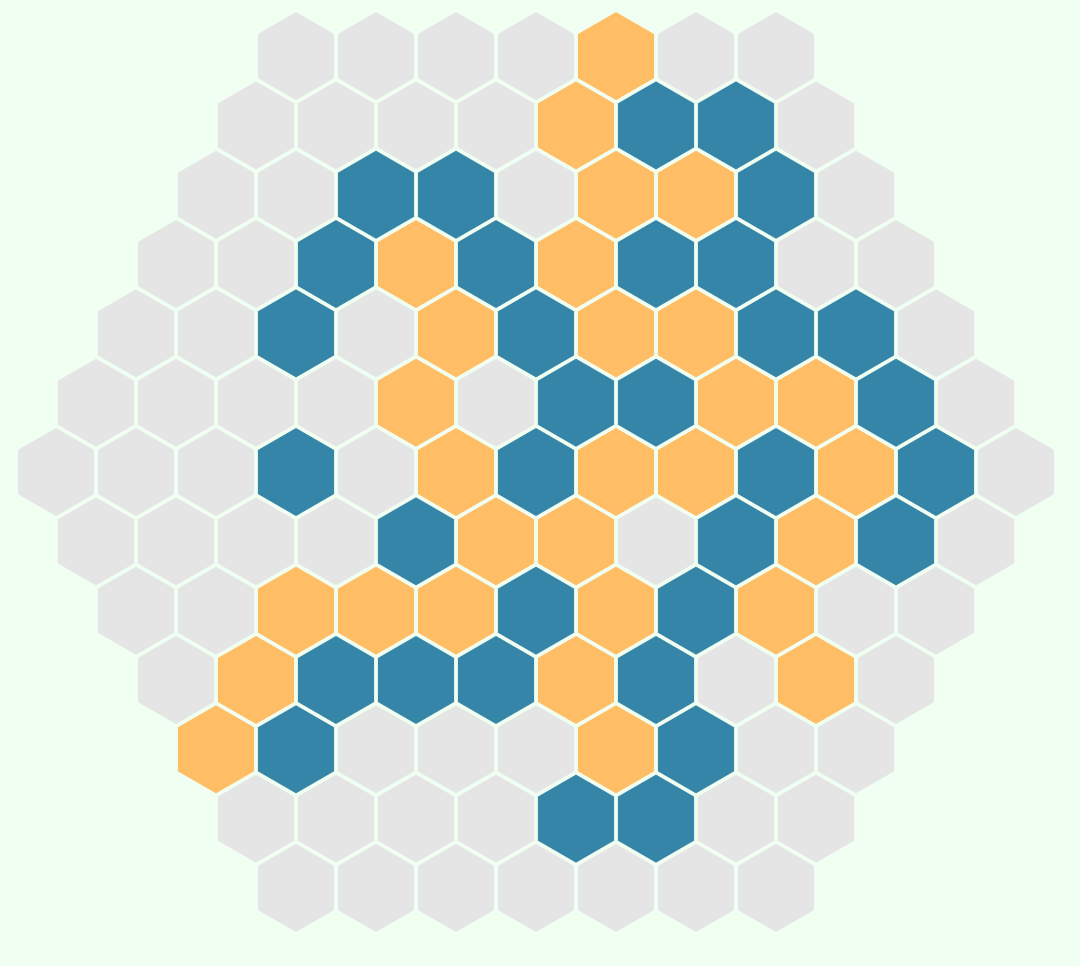
Links
- Article by Nick Bentley - rules, a lot of links, print-and-play,
- Board Game Geek
4 - Chess
Classic board game chess
Chess is classic board game. Probably the most popular board game in the world, at least in Europe and in America.
 Raffaello Sorbi - La partita a scacchi/Chess game
Rules
Standard chess is played on an 8x8 board. White moves first. Each side starts with a king, queen, two rooks, two bishops, two knights, and eight pawns. The aim is to checkmate the opponent’s king.
The usual piece movement is used:
- King: one square in any direction; castling is allowed when the normal castling conditions are met.
- Queen: any distance horizontally, vertically, or diagonally.
- Rook: any distance horizontally or vertically.
- Bishop: any distance diagonally.
- Knight: an L-shaped jump: two squares in one direction and one square perpendicular.
- Pawn: one square forward, optionally two from its starting square, captures one square diagonally forward, can capture en passant, and promotes on the last rank.
A player who has no legal move while in check is checkmated and loses. A player who has no legal move while not in check is stalemated and the game is drawn.
External detailed references:
- wikipedia.org chess
- wikipedia.org chess rules
- FIDE - International Chess Federation
- chess.com animated and videos
Variant - Chess960
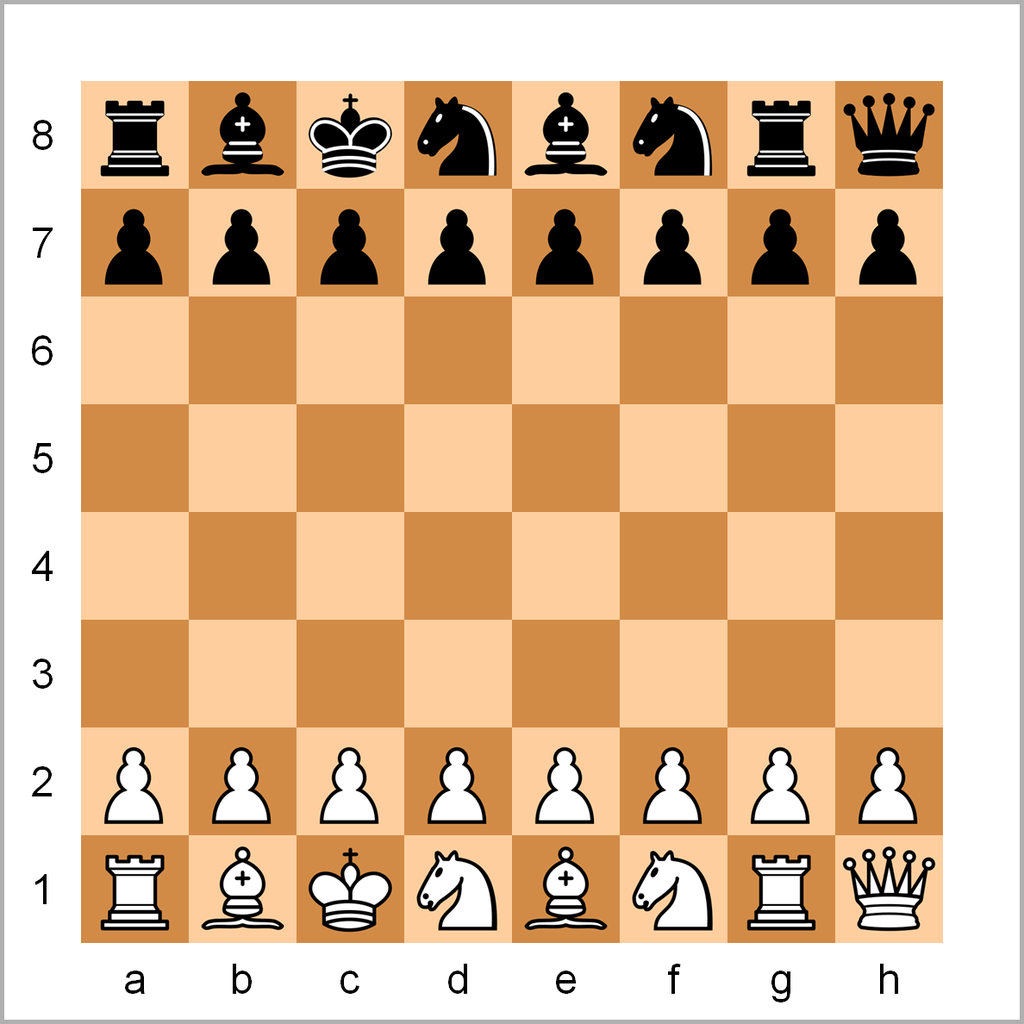
Chess960 is also known as Fischer random chess or Chess9LX. Chess960 uses the same board, pieces, and goal as standard chess. The starting position of the back-rank pieces is randomized. The bishops must start on opposite-colored squares, and the king must start somewhere between the two rooks. Pawns start on the usual second and seventh ranks.
Castling still exists, but the final castled positions are the same as in standard chess: after kingside castling the king is on the g-file and the rook on the f-file; after queenside castling the king is on the c-file and the rook on the d-file. The usual requirements still apply: neither king nor castling rook has moved, the king is not in check, and the king does not pass through or land on an attacked square.
More on wikipedia
Variant - Crazyhouse
Crazyhouse is a popular chess variant similar to bughouse, but you only need two players to play. The basic premise of crazyhouse is that pieces which you capture from your opponent can be dropped on empty squares on your turn.
Captured pieces change color and go into the capturer’s reserve. On a turn a player may either make a normal chess move or drop one reserve piece on an empty square.
Little Golem follows the usual Crazyhouse restrictions:
- Pawns may not be dropped on the first or eighth rank.
- Dropped pieces give check normally.
- A promoted pawn that is captured returns to reserve as a pawn, not as the piece it promoted to.
- Checkmate and draw conditions otherwise follow chess.
More on wikipedia
Variant - Grand Chess
Grand Chess is a large-board chess variant invented by Dutch games designer Christian Freeling in 1984. GM Larry Kaufman has written that Grand Chess “really is an excellent game and deserves a bigger following”.

Grand Chess is played on a 10x10 board. Each side has the normal chess pieces plus two extra pawns and two compound pieces:
- Marshall: moves as a rook or a knight.
- Cardinal: moves as a bishop or a knight.
There is no castling. Pawns may move one or two squares from their starting rank and may capture en passant. Promotion is restricted: a pawn may promote only to a piece of the same color that has already been captured. A pawn can choose to promote on the eighth or ninth rank, and must promote on the tenth rank if a captured piece is available.
It is best to read about Grand Chess directly on the author’s website: www.mindsports.nl
Variant - Seirawan Chess
Seirawan Chess was invented by GM Yasser Seirawan and Bruce Harper. In Seirawan Chess (S-chess) the rules are the same as in orthodox chess, except that two pieces, the Elephant and the Hawk, are placed in the reserve. The Elephant (Chancellor) combines the powers of a Rook and a Knight. It is comparable in strength to the Queen. The Hawk (Cardinal) combines the powers of a Bishop and a Knight. It is somewhat weaker than a Queen. These pieces are known from Capablanca’s Chess.
Whenever a non-pawn piece leaves its original back-rank square for the first time, the player may immediately place one reserve piece on the square just vacated. This is a single turn containing both the normal move and the gated piece placement. If the player declines to gate a reserve piece from that square, that square cannot be used for gating later.
When castling, a reserve piece may be gated on either square vacated by the king or rook. Pawns may also promote to Elephant or Hawk.
5 - Conhex
Game invented by Michail Antonow in 2006
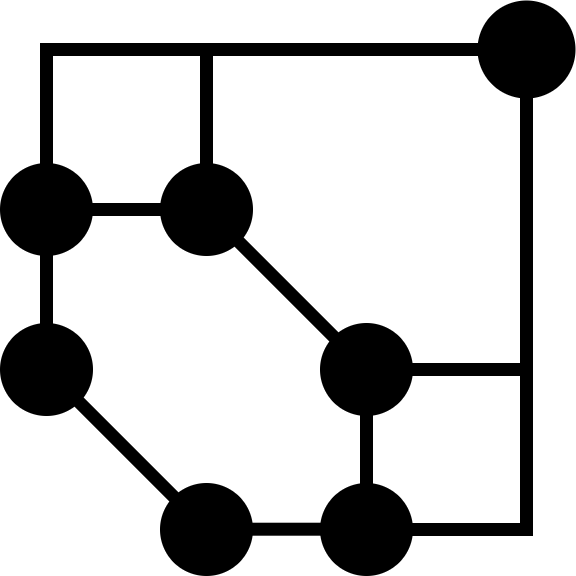
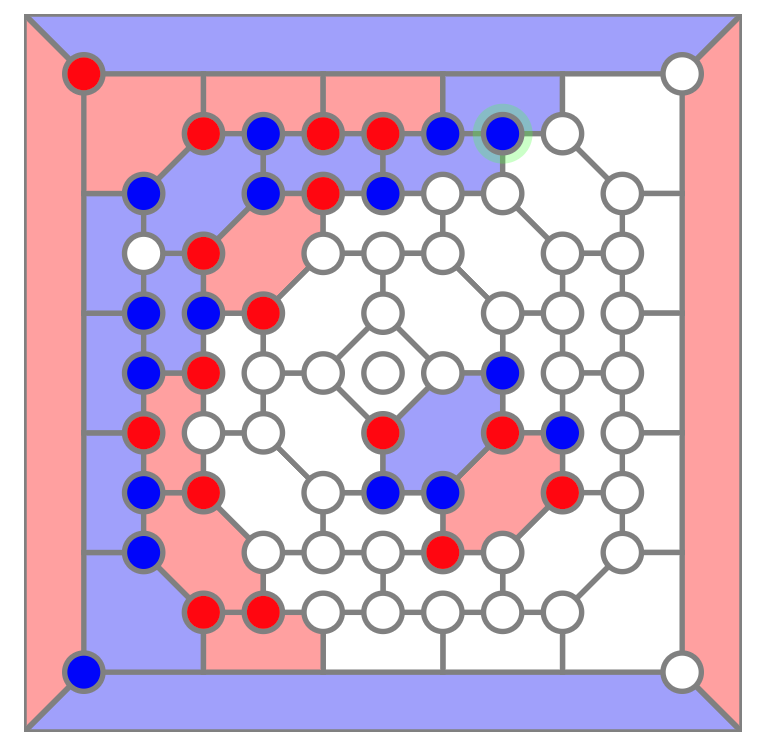
Conhex is a two-player connection game invented by Michail Antonow. The goal is to claim a connected chain of spaces between the player’s two assigned sides. The board is made of polygonal spaces. Players do not place stones inside the spaces directly; they place stones on the vertices around them.
Rules
Blue moves first. A move is made by placing one stone on any empty playable vertex. Some visual points on the board are gaps and cannot be played.
After a stone is placed, every still-unclaimed space is checked. A player claims a space as soon as that player owns at least half of the playable vertices around it. For example, a four-vertex space is claimed with two vertices, and a five-vertex space is claimed with three vertices. Once a space is claimed, it keeps that owner.
The first player who connects their two opposite sides with a connected group of claimed spaces wins.
On Little Golem:
- Blue connects the bottom side to the top side.
- Red connects the left side to the right side.
- Spaces are connected when they share at least one vertex.
- Draw offers are possible, but the game itself has no normal draw condition.
Swap move
Conhex uses the swap rule. After Blue’s first placement, Red may play swap
instead of placing a normal stone. The swapped stone is moved to the reflected
point used by the Little Golem board geometry, and the colors continue from
there with Blue to move.
Links
6 - Oceans 11
A two player game using poker hands invented by Eliott Adkins.
Rules (from pagat.com)
Introduction
A two player game using poker hands. Instead of betting players have to decide how to deploy their 54 cards to win the best of 11 poker hands.
The Deck(s)
Two standard international 54-card (52 cards and 2 jokers) decks (one for each player).
Cards have their usual ranking as in Poker.
Object of the Game
Be the first player to win 6 hands of poker.
Play
To start, each player shuffles their individual deck, and flips the top card face up.
These cards form the start of each player’s poker hand, and are compared.
Each time a card is revealed, the up-cards are compared to see which player has the stronger poker hand.
The player with the weaker hand must choose between two options:
- Deal another card from their deck and add it to the row of face-up cards in front of them, to try to improve their poker hand.
- Concede the hand to the other player.
If a player deals another card, the rows of up-cards are again compared to see which player is weaker, and the lower hand again has the same options as above.
If the two players have equally high hands, both must deal an additional card face-up.
This continues until one of the players concedes. All the face-up cards are then discarded, and will not re-enter play. Normal practice is for the player who won the hand (did not concede) to place one of the used cards apart from their discard pile, to keep track of the number of hands won. Each player then deals the next card of their deck face up to start the next hand.
There is no limit to the number of cards the player with the weaker hand may expose in an effort to win the hand, except that a player who runs out of cards is forced to concede, having no more cards to deal.
Comparing Hands
When comparing hands, each player makes their best five-card poker hand from the row of cards in front of them. If there are fewer than five cards, the hand is ranked as though the remaining cards are worthless non-matching cards with no rank and no suit.
End of the Game
The first player to win 6 hands is the winner of the game.
It follows that once a player is at 5 wins, their opponent cannot concede a hand early unless they run out of cards. When a player runs out of cards, their opponent wins the current hand and then can win additional hands by simply playing one card from their stock, as long as their stock persists. If both players run out of cards, the player with the most wins is the champion.
If they win an equal number of hands, the game is a draw.
Variants
On LittleGolem, the basic variant is played with 2 wild cards (jokers). Other possible variants are:
- play without wild cards (52 card deck)
- deuces are also wild cards
- play with 65 cards (5 suits) for 13 hands instead of 11
- mini version where everyone has half a deck of cards (26) for 5 games or 27 cards (one joker in deck).
Links
- Pagat - Rules, Info
- Board Game Geek
7 - Connect6
Connect6 introduced in 2003 by Professor I-Chen Wu
Rules
The rules of Connect6 are very simple and similar to the traditional game of Gomoku:
- Players and stones: There are two players. Black plays first, and White second. Each player plays with an appropriate color of stones, as in Go and Gomoku.
- Game board: Connect6 is played on a square board made up of orthogonal lines, with each intersection capable of holding one stone. In theory, the game board can be any finite size from 1×1 up (integers only), or it could be of infinite size. However, boards that are too small may lack strategy (boards smaller than 6×6 are automatic draws), and extremely large or infinite boards are of little practical use. 19×19 Go boards might be the most convenient. For a longer and more challenging game, another suggested size is 59×59, or nine Go boards tiled in a larger square (using the join lines between the boards as additional grid lines).
- Game moves: Black plays first, putting one black stone on one intersection. Subsequently, White and Black take turns, placing two stones on two different unoccupied spaces each turn.
- Winner: The player who is the first to get six or more stones in a row (horizontally, vertically, or diagonally) wins. (This is a departure from Gomoku, where it must be exactly five in a row.)
According to Professor Wu, the handicap of black’s only being able to play one stone on the first turn means that the game is comparatively fair; unlike similar games such as Gomoku and Connect Four, which have been proven to give the first player a large advantage, possibly no additional compensation is necessary to make the game fair.
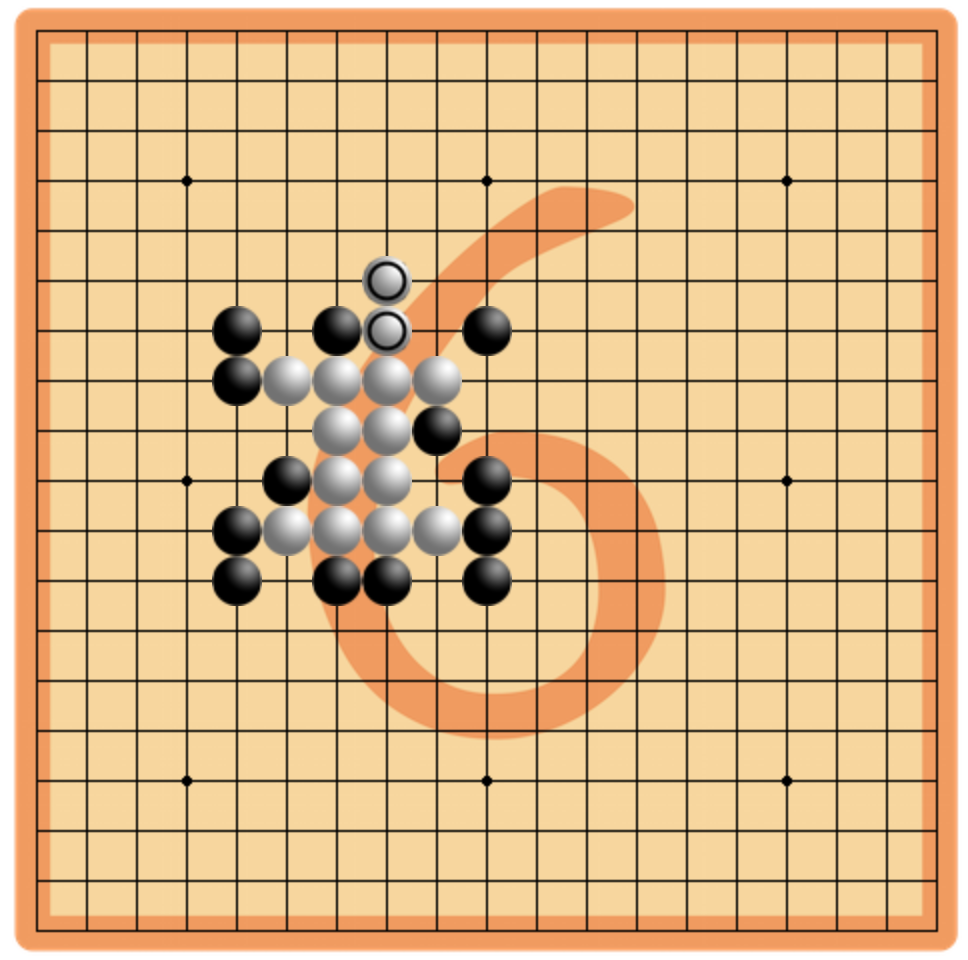
Links
- Wikipedia - Rules, History
- Board Game Geek
8 - Dots and boxes
Invented in 1889 by the French mathematician François Edouard Anatole Lucas
Rules
Each player must alternately draw dashes joining adjacent vertical or horizontal dots. If you are able to complete a square, you mark it as your own and you must draw another dash. At the end of the game, players achieve long runs of squares. When all squares are claimed, the game ends, and the winner is the player with the most squares.
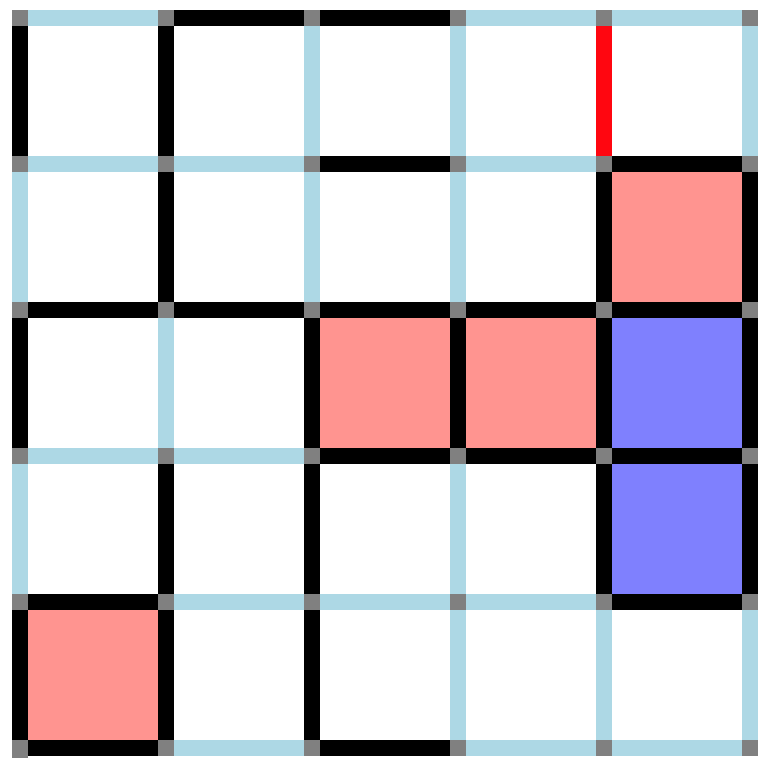
Variants
On Little Golem is game played on boards: 4x4, 5x5, 6x6 and 7x7.
Links
- Wikipedia
- The Dots and Boxes Game: Sophisticated Child’s Play - book by Elwyn R. Berlekamp
9 - Draughts
Classic board game
 Gustave Courbet The Draughts Players 1844
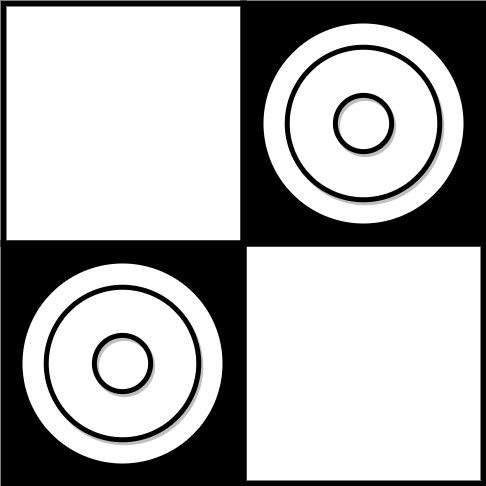
Variants
On Little Golem is played several variants.
English Draughts
English draughts, also called checkers or straight checkers, is played on an 8x8 board with 12 men per side. Only the dark squares are used. Black moves first on Little Golem.
Men move one square diagonally forward to an empty square. Men capture by jumping diagonally forward over an adjacent enemy piece to the empty square beyond it. Kings move one square diagonally in any direction and capture one square in any diagonal direction.
Capturing is compulsory. If several captures are available, Little Golem allows any capturing line in English draughts; the maximum-capture rule is not applied to this variant. Multiple jumps are made in one move when the same piece can continue capturing.
A man that reaches the far row is promoted to a king. A player loses when they have no legal move left.
For English Draughts Championship tournaments on Little Golem, games use random three-move openings from the official tournament deck. Other tournaments and ordinary games use GAYP, “go as you please”.
Links
- Wikipedia
- WCDF - World Checkers and Draughts federation
- Board Game Geek
International draughts
International draughts is played on a 10x10 board with 20 men per side. Only the dark squares are used. White moves first on Little Golem.
Men move one square diagonally forward to an empty square. Men capture diagonally forward or backward by jumping over one adjacent enemy piece to the empty square beyond it.
Kings are flying kings: they move any distance diagonally through empty squares. They capture by jumping over one enemy piece on a diagonal and landing on any empty square beyond it on the same diagonal.
Capturing is compulsory. When more than one capture is possible, Little Golem requires a line that captures the maximum number of pieces. A man promotes when it reaches the far row. A player loses when they have no legal move left.
Links
- Wikipedia
- Board Game Geek
- FMJD - World Draughts Federation
Dameo
Dameo is an abstract strategy board game for two players invented by Christian Freeling in 2000. It is a variant of the game draughts (or checkers) and is played on an 8×8 checkered gameboard.
Dameo is played on an 8×8 checkerboard with 18 pieces per player. Each player’s pieces are arranged so that the bottom three rows, from the perspective of the player, are filled from a1 to h1, b2 to g2, and c3 to f3, forming a distinctive trapezoid shape.

- White moves first on Little Golem.
- Men move forward, either straight ahead or diagonally forward.
- A line of adjacent friendly men may make a linear move: the rear man moves along the line to the first empty square beyond the friendly line.
- Captures are orthogonal only. A man captures one square forward, backward, or sideways by jumping an adjacent enemy piece.
- Kings move any distance in eight directions. Kings capture orthogonally by a long jump over one enemy piece to an empty square beyond it.
- Capturing is compulsory. Little Golem allows any legal capturing line in Dameo; it does not filter to maximum captures in the same way as International draughts.
- Captured pieces are removed at the end of the move. The same enemy piece may not be captured twice in one move.
- A man promotes when it reaches the far row. A player loses when they have no legal move left.
Links
10 - Dvonn
Invented by Kris Burm in 2001

DVONN is a two-player strategy board game in which the objective is to accumulate pieces in stacks. It was released in 2001 by Kris Burm as the fourth game of the GIPF Project. DVONN won the 2002 International Gamers Award and the Games magazine Game of the Year Award in 2003.
Rules
DVONN is played on a 49-space elongated hex board with:
- 23 white pieces
- 23 black pieces
- 3 neutral red DVONN pieces
The game has two phases.
Placement
The first three placements are the red DVONN pieces. After that, players place their own pieces until the board is full. On Little Golem, White places the first red piece, Black places the first normal piece, and White gets the last normal piece automatically when only one empty space remains.
Movement
White makes the first move in the movement phase.
A stack belongs to the player whose color is on top. A stack can move only if it is free, meaning it is on the edge or has at least one empty neighboring space.
A stack moves in a straight line exactly as many spaces as its height. It may jump over occupied or empty spaces, but it must land on an occupied space. The moving stack is placed on top of the destination stack.
Single red DVONN pieces do not belong to either player and cannot move by themselves. Once a red piece is part of a stack, that stack is controlled by the color on top.
After every move, any stack or group of stacks not connected to at least one red DVONN piece is removed from the board.
If a player has no legal move, they pass. Passing is only legal when no move is available. The game ends when neither player has a legal move.
Scoring
Each player scores the total height of all stacks they control. The higher score wins. Equal scores are a draw.
Links
11 - Backgammon
Rules, controls, computer opponents and game analysis.
Backgammon is a race for two players, combining checker play with dice and, in match play, decisions about the doubling cube. Little Golem supports two formats:
| Format | Board | Scoring and doubling |
|---|---|---|
| Single game | Green | One game, without a doubling cube. The first player to bear off all fifteen checkers wins. |
| 7-point match | Orange | A sequence of games until a player reaches at least seven points, with a doubling cube and the Crawford rule. |
Both formats support computer opponents and analysis of completed games.
Moving the checkers
Each player has fifteen checkers. From that player’s perspective, start with two on point 24, five on 13, three on 8 and five on 6, moving toward point 1. Each player rolls one die to start; ties are rerolled. The higher roller starts using both dice. Later turns use two dice; doubles allow four moves.
A checker can land on an empty point, a friendly point or a single opposing checker. A lone opposing checker is hit onto the bar and must re-enter before other checkers move. Two or more opposing checkers block a point. Use as many dice as legally possible. If only one unequal die can be used, use the higher one if possible. Bearing off starts only when all remaining checkers are in the home board. An oversized die can bear off only the checker furthest from the exit. The first player to bear off all checkers wins.
Match scoring and the doubling cube
In a seven-point match, an ordinary win scores one point, a gammon two (the loser has borne off none), and a backgammon three (also a losing checker on the bar or in the winner’s home board), multiplied by the doubling cube. Before rolling, a player may offer a double if the cube is centered or owned by that player. Acceptance doubles its value and gives ownership to the accepting player. Refusal loses the game at its previous value. Further doubles are disabled when the current cube already guarantees the match to either game’s winner. The first player to reach at least seven points wins the match.
Crawford rule
When either player first reaches six points, the next game is the Crawford game: doubling is forbidden for that game only. The cube returns in subsequent games. Each new game starts with a centered cube of value one. Little Golem does not use the Jacoby rule, beavers or automatic doubles.
Playing on Little Golem
Rolling and choosing the dice order
The opening roll is automatic. On later turns, the dice roll automatically when you have no legal doubling decision. If you can offer a double, choose between the cube and Roll, which appears on the board where the dice normally sit.
New rolls display the higher die first. Click or tap the dice to swap their order. Reopening the game preserves a roll that has already been made; it does not give you another roll or another opportunity to double before it.
Moving and sending a turn
- Click or tap one of your checkers. It moves using the first available die in the displayed order, or the other die if the first cannot legally be used from that point. You do not need to select a destination.
- Continue moving until you have used all the dice that can legally be played. Used dice fade. A double provides four moves.
- Use Undo on the board to revise an unsent checker move.
- Press the standard Send move button below the game to submit the completed turn.
You can also drag a checker to a legal destination. Enter checkers from the bar before moving any others; when bearing off, you can tap a checker or drag it to your Off tray. The interface enforces the requirement to use as many dice as possible, including the higher-die rule. If no checker can move, use Send move to submit the forced pass.
Moving checkers on the board prepares your turn; it does not send each individual checker move to your opponent. Rolling is recorded immediately.
Offering and responding to a double
In a 7-point match, click or tap the doubling cube before rolling to prepare a double, then press Send move. Use Cancel to discard an unsent cube decision.
When your opponent offers a double, choose on the board:
- Take: accept the new value and take ownership of the cube.
- Drop: concede the current game at the previous cube value.
Confirm either response with Send move. After a take, the player who offered the double resumes their turn and rolls; the accepting player does not immediately move.
The cube starts in the center. After an accepted double, it moves to the accepting player’s side, showing who may offer the next double. It is centered while an offer awaits a response. During the Crawford game it cannot be used. Single games do not display a doubling cube.
Playing against a bot
Little Golem offers five computer-opponent levels powered by GNU Backgammon for both formats. Sign in, open Robots, select Backgammon, choose the format and an opponent, then select Play.
The levels use different engine settings. The ratings shown on the opponent cards are their current Little Golem ratings, not fixed Elo promises for an engine level. Bots follow the same rules as human players, including cube decisions in a 7-point match.
Analysing a completed game
GNU Backgammon analysis is available for completed single games and completed 7-point matches. Allow time for processing after the game finishes. Open the completed game to see its evaluation panel, or use Learning → My analyses to find games whose analysis is ready. If the panel is hidden, leave the full-screen board view.
For an analysed decision, you can compare the move played with the engine’s recommended move and other alternatives. Match analysis also evaluates cube decisions: whether to roll or double, and whether to take or drop.
The evaluation uses match-winning chance (MWC): an estimated probability of winning. For a single game, this is the chance of winning that game; for a 7-point match, it includes the match score, cube and Crawford state. The graph shows player 1’s chance. Individual decision comparisons use the perspective of the player making that decision.
Decision loss is expressed in percentage points relative to the engine’s preferred choice in the same position, with the same dice. A change in the graph after a roll can also reflect the luck of the dice, so it should not automatically be read as a playing mistake.
The Analyse button opens a local board where you can explore moves. It does not request or start the server’s GNU Backgammon evaluation.
Rules reference: USBGF.
12 - EinStein würfelt nicht!
Game invented by Ingo Althöfer in 2005
The name of the game in German has a double meaning. It is a play on Einstein’s famous quote “I am convinced that He (God) does not play dice” and also refers to the fact that when a player has only one cube (ein Stein) remaining, they no longer need to “play dice”, and may simply move the cube.
Rules
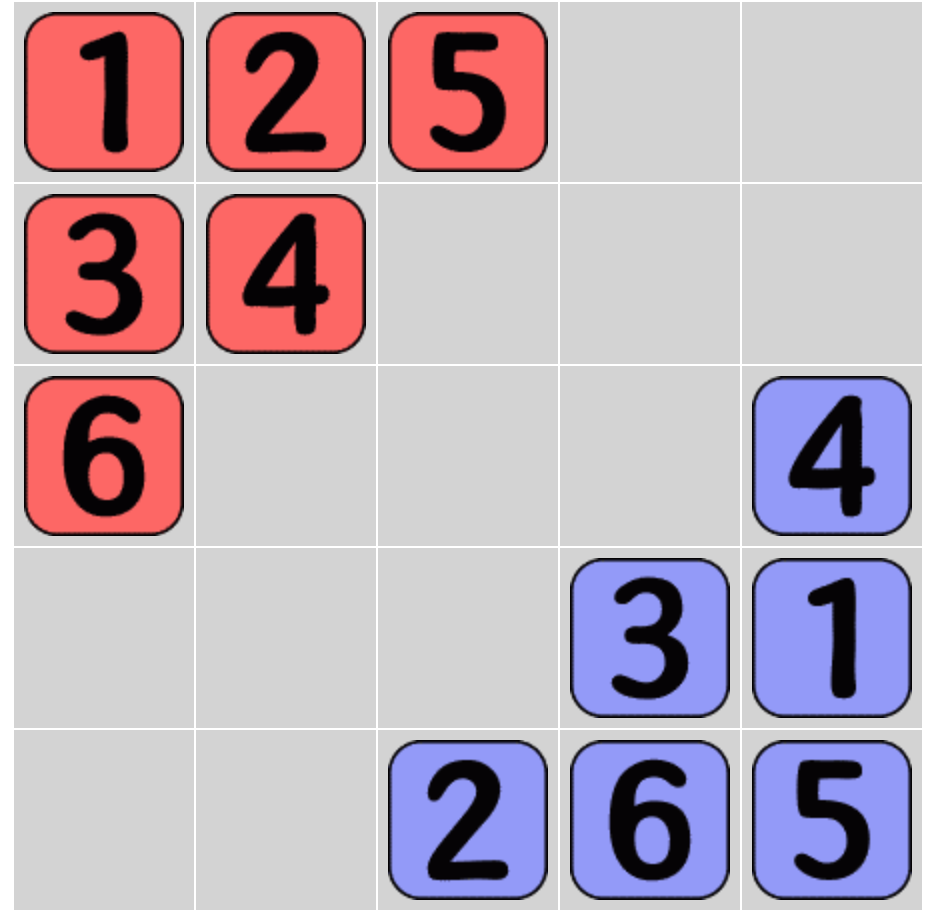
The game is played on a square board with a 5×5 grid. Each player has six cubes, numbered one to six. During setup, players arranges the cubes within the triangular area of their own color.
The players take turns rolling a six-sided die and then moving the matching cube. If the matching cube is no longer on the board, the player moves a remaining cube whose number is next-higher or next-lower to the rolled number. The player starting in the top-left may move that cube one square to the right, down, or on the diagonal down and to the right; the player starting in the bottom-right may move that cube one square to the left, up, or on the diagonal up and to the left. Any cube which already lies in the target square is removed from the board.
The objective of the game is for a player to either get one of their cubes to the far corner square in the grid (where their opponent started) or to remove all of their opponent’s cubes from the board.
Variants
On Little Golem are played 7 variants according to lenght of match: 1,3,5,7,11,19,50 points match.
Blackhole variant has black hole in middle of board, where stone is lost. Game is played as 3 points match.
Backwards capture variant allow backward capture move. Game is played as 3 points match.
Links
13 - Fendo
A modern abstract board game by Dieter Stein.
Information
Fendo is probably Dieter Stein’s best board game. It meets exactly all the prerequisites for a perfect abstract game: very simple rules, deep strategy and tactics. In addition, there is no possibility of a draw in the game. The game is also very nicely aesthetically made of wood.
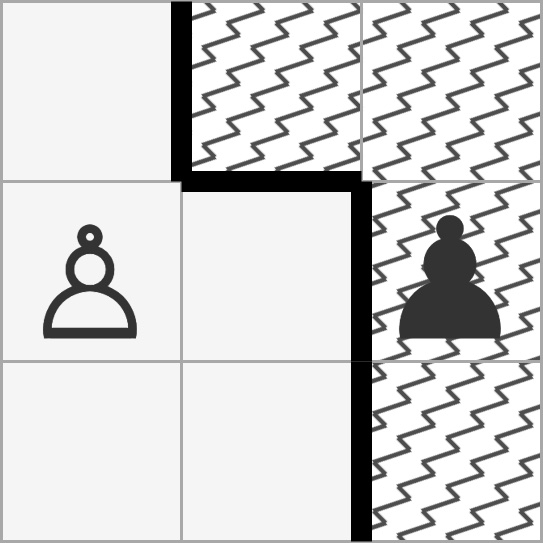
Rules
Fendo is played on a 7x7 square board. Each player has seven pieces. On Little Golem the red player starts on the middle square of the left edge and the blue player starts on the middle square of the right edge. Each player has six remaining pieces in hand. Fences are shared by both players.
The aim is to enclose more board squares than the opponent. A closed area is a region of squares surrounded by board edges and fences. A closed area belongs to the color of the single piece inside it. Areas with no piece, or with pieces of both players, are not scored for either player.
On a turn a player must make one of these actions:
- Move one of their pieces in the open area and then build one fence.
- Add one new piece from hand to an empty legal square.
A moved piece travels horizontally or vertically through empty squares. It may move any distance and may make at most one right-angle turn. It may not cross a fence, pass through another piece, enter a closed area, or move diagonally. It is legal to keep the selected piece on its current square, provided a legal fence can then be built there.
After moving a piece, the player builds one fence on an empty side of the piece’s final square. The fence must keep the board position legal: after the fence is added there may not be two separate open areas. In practical terms, closing an area is legal only when the newly closed area contains exactly one piece.
A new piece may be added on an empty square that is reachable by one legal Fendo move from one of the player’s pieces in the open area. Adding a piece does not add a fence.
The game ends when no open area remains and the whole board is split into closed areas. Each player scores the total number of squares in areas owned by their pieces. The higher score wins.
Little Golem notes
Little Golem uses the 7x7 variant. The move notation shown in game records is:
A1-B1/estyle display for moving a piece and building a fence on the east side of the destination.- A single coordinate for adding a piece from hand.
Resignends the game immediately.
Links
14 - Four in a row
Invented in 1974

Four in a row is two-player connection board game, in which the players choose a color and then take turns dropping colored discs into a seven-column, six-row vertically suspended grid. The pieces fall straight down, occupying the lowest available space within the column. The objective of the game is to be the first to form a horizontal, vertical, or diagonal line of four of one’s own discs.
Variants
Game on Little Golem is played on four board sizes: 6x7 (classic), 8x8, 9x9, 10x10
Links
15 - Gomoku
Classic game from ancient China
Gomoku, also called Five in a Row, is an abstract strategy board game. It is traditionally played with Go pieces (black and white stones) on a Go board. Because pieces are typically not moved or removed from the board, gomoku may also be played as a paper-and-pencil game. The game is known in several countries under different names.
Rules
Players alternate turns placing a stone of their color on an empty intersection. Black plays first. The winner is the first player to form an unbroken chain of five stones horizontally, vertically, or diagonally.
Variants
Gomoku
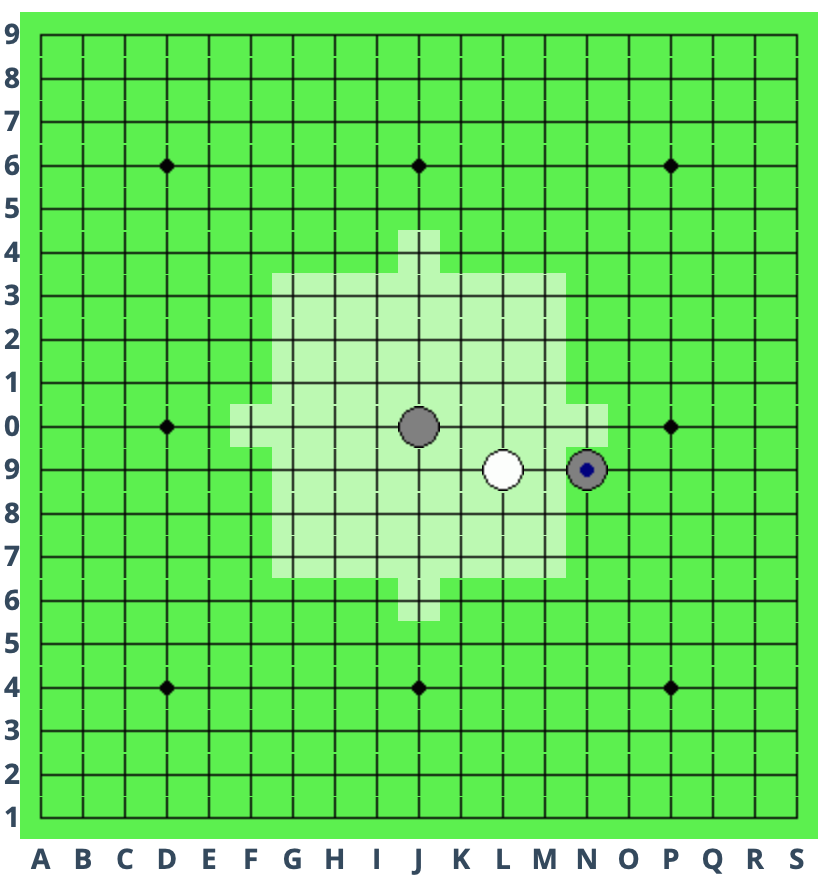
- Played on a 19x19 board.
- The first black stone is always in the center.
- Black’s second stone must be outside the marked restricted region shown in the app.
- A line of five or more stones wins.
- If the game reaches 150 moves without a winner, Little Golem declares a draw.
Gomoku Pro
- The game is played on a 15x15 board.
- The first player opens by placing 1, 2, 3, 4, or 5 stones.
- The stones in that opening alternate colors, starting with black.
- The second player may accept the colors or play
swap. - After the opening and optional swap, players place one stone per turn.
- A line of five or more stones wins.
- There is no draw. If the player to move can no longer make any five-in-a-row anywhere on the board, that player loses.
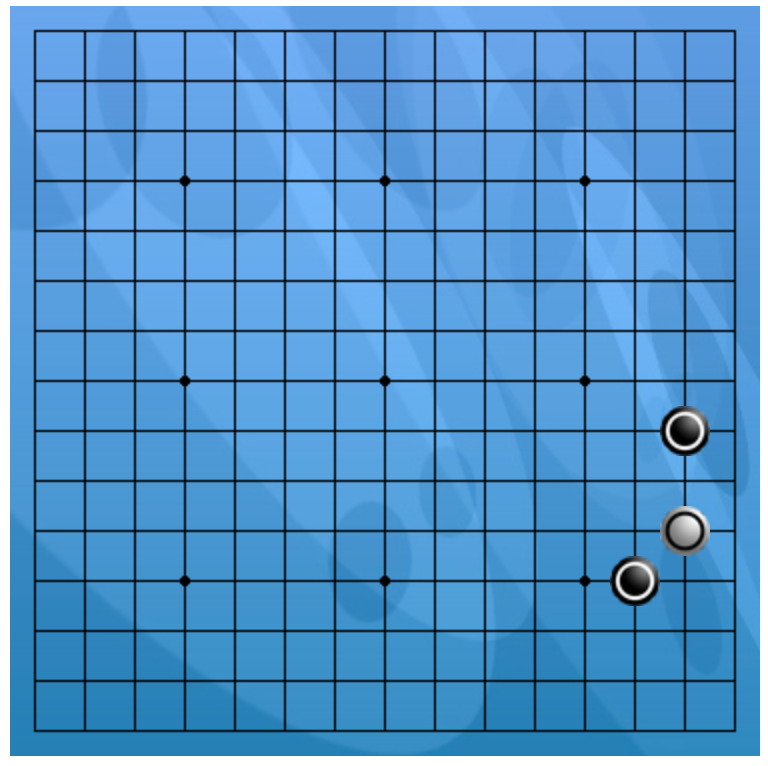
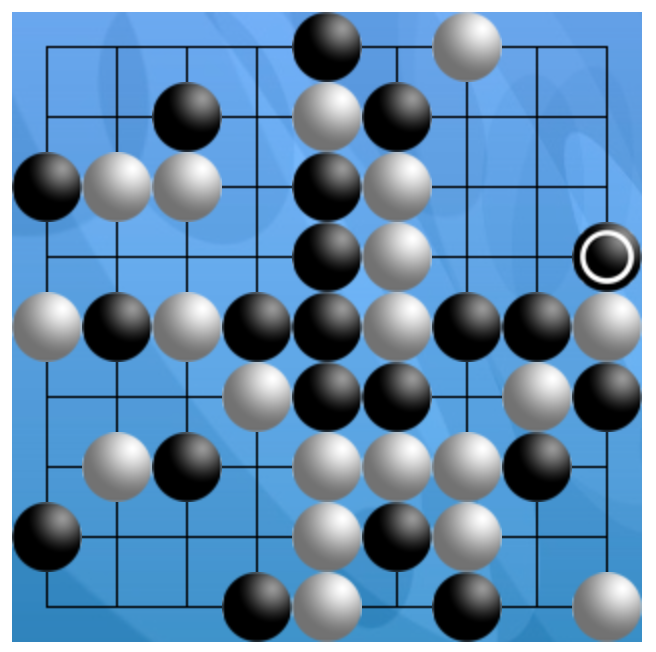
Gomoku Pro 9x9
Gomoku Pro 9x9 uses the same Pro rules on a 9x9 board. In the picture black is the winner.
Links
16 - Go
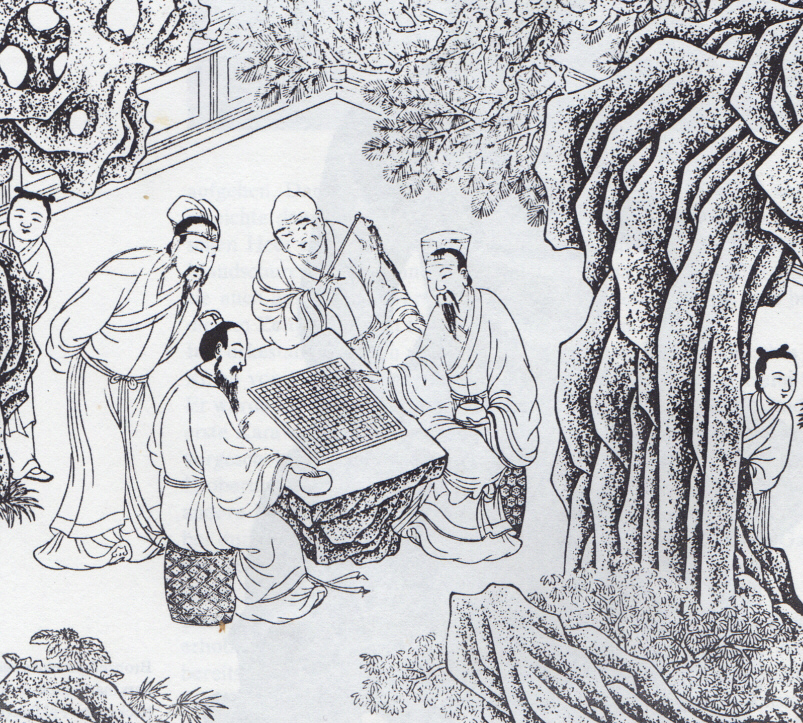
Game invented in China 2500 years ago
Rules
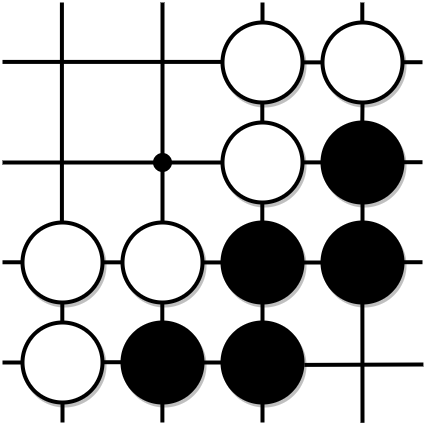
The playing pieces are called stones. Black moves first, then players alternate placing one stone on an empty intersection. Stones do not move after placement.
Adjacent stones of the same color form a group. Empty intersections adjacent orthogonally to a group are its liberties. If a move removes the last liberty of one or more opponent groups, those stones are captured and removed from the board. A move that would leave the played stone or its group with no liberties is illegal unless it captures opposing stones at the same time.
The ko rule forbids immediately recreating the previous board position by recapturing a single stone. A player may pass. Two passes start scoring.
For square-board Go variants on Little Golem, scoring is handled by a score proposal. Hexagonal Go uses the separate agreement process described below.
- After two passes, a player marks dead stones and sends a
scoremove. - The opponent may accept the proposal with
accept. - The score counts territory plus captured prisoners, with komi added for White.
- A player may also resign.
Go has simple rules but is extremely complex.
Rules of Go on Wikipedia.
Variants on Little Golem
Sizes 9x9, 13x13, 19x19, 27x27, 37x37
There are five square-board sizes with ordinary edges. The standard game is 19x19. These sizes use komi 6.5 unless the game setup explicitly stores another komi value.
Hahn Pointing System
The Hahn Pointing System is a new method to determine the tournament winner using points earned as a result of each game in place of the players win/loss record. Professor Sang-Dae Hahn of Myongji University developed the system to foster aggressive, fighting games with an emphasis on reading.
The Hahn system is based upon the scoring used in bangneki. Points are awarded to the winner and the loser of the game based upon the result. A single game is worth 100 points. The 100 points are divided between the winner and the loser based upon the difference in count at the end of the game.
A difference of 0.5 to 10 in the count results in the winner receiving 60 points and the loser receiving 40 points.
A difference of 10.5 to 20 in the count results in the winner receiving 70 points and the loser receiving 30 points.
A difference of 20.5 to 30 in the count results in the winner receiving 80 points and the loser receiving 20 points.
A difference of 30.5 to 40 in the count results in the winner receiving 90 points and the loser receiving 10 points.
A difference of more than 40 points results in the winner receiving all 100 points and the loser receiving no points.
The tournament winner in a Hahn pointing system scored tournament is the player with the most points, regardless of the player’s win/loss record in the tournament. Therefore, a player with 580 points and a win/loss record of 5-2 beats a player with 570 points and a perfect win/losss record of 7-0.
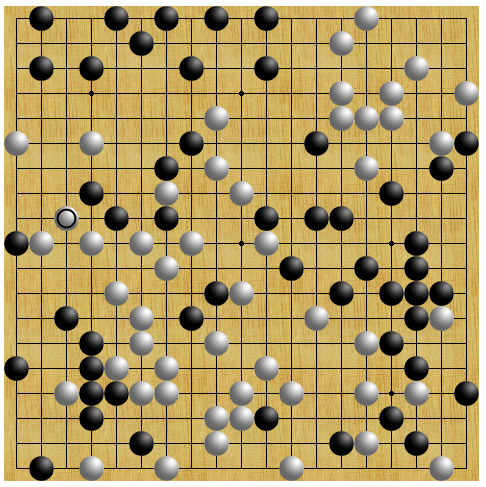
Random board
Players play from a position, where there are already 100 stones on the board. The positions have been checked for equality by the computer.
Toroidal Go: 11x11 and 17x17
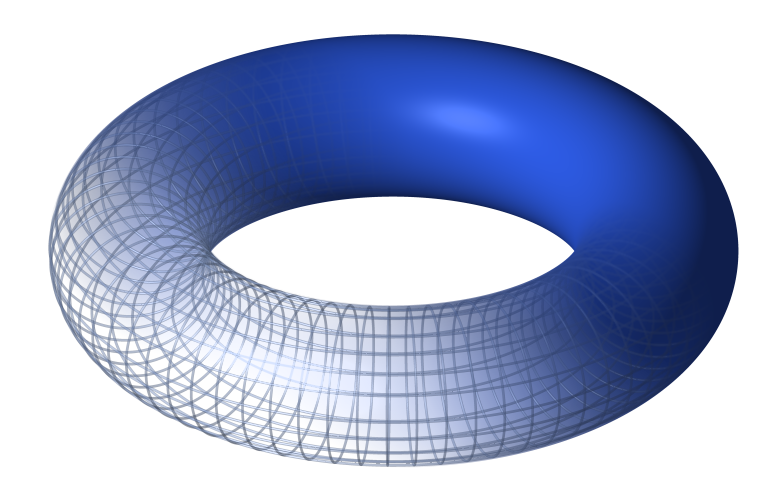
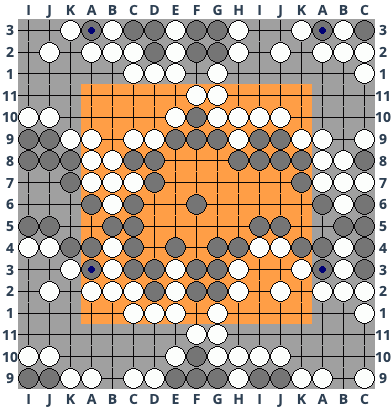
Toroidal Go is played on an 11x11 or 17x17 board with wrap-around edges. The top edge is adjacent to the bottom edge, and the left edge is adjacent to the right edge. Each intersection still has four neighbours, but there are no corners or true edges. Connections, liberties, captures and territory continue across the opposite sides of the board.
| Board | Intersections | Komi for White |
|---|---|---|
| 11x11 | 121 | 4.5 |
| 17x17 | 289 | 5.5 |
The larger board is a separate variant; existing 11x11 games keep their rules. Komi is fixed by each game’s setup. Both sizes use the square-board Go scoring proposal and acceptance process described above.
The app repeats strips of the board around the central playing area to show connections across the edges. These are copies of the same intersections, not extra playing spaces. On the 17x17 board, nine star points at the intersections of lines 4, 9 and 14 help with orientation.
Hexagonal Go (HexGo)
HexGo uses a hexagonal board with eight intersections along each side and 169 intersections in total. An interior intersection has six neighbours instead of four. Groups, liberties and captures follow these six directions; the board does not wrap around.
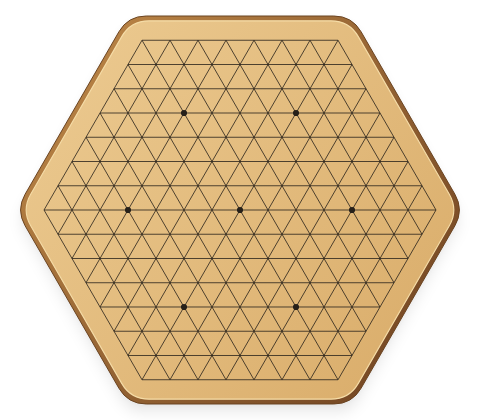
The HexGo board in the app. The dark star points are orientation marks, not stones.
Black plays first and players alternate placing one stone. A move removes opponent groups with no liberties before checking the played group’s liberties. Suicide is forbidden. Positional superko forbids a placement that recreates any earlier board position, not only the immediately previous position. Players may also resign.
HexGo uses Chinese area scoring: count each player’s stones on the board plus empty intersections surrounded by that player. Captured prisoners do not add separate points. White receives komi, normally 5.5, fixed by the game’s setup.
To finish a game, both players must agree to the same score:
- Choose PASS to preview a score proposal. The board shows ownership and marks stones assessed as dead with crosses. Opening this preview does not submit a move or accept the score.
- If you agree, use Send to submit the pass and its score proposal.
- The opponent can choose PASS, review the same proposal, and use Send to accept it. This second consecutive pass ends the game with that score.
- If either player disagrees, continue playing stones. A placement cancels the pending agreement; a later pass will propose a score for the new position.
The score preview is an estimate of life and death, not a forced adjudication. Check it before accepting, and continue play when a group or disputed area needs to be resolved. The opponent accepts the exact proposal already submitted; it is not recalculated between the two passes.
Links
- Wikipedia
- SenSei Library - site with 23000 pages about Go
- Go Books on iPad
17 - Golem word game
The game was created especially for Little Golem.
Rules
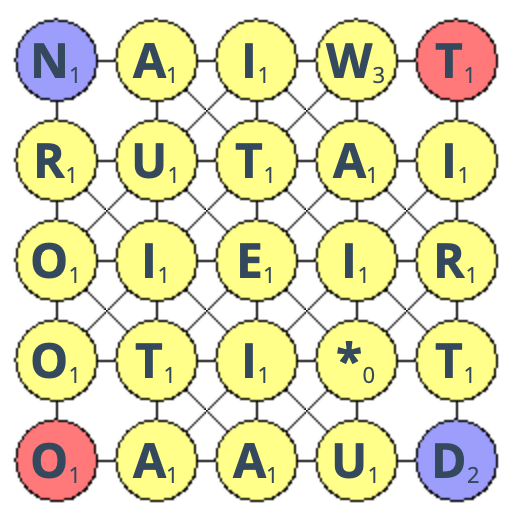
Golem’s word game is word game for two players. Target of game is finding words on board. Each player takes out tiles from board and these tiles are replaced by other tiles from bag. Order of tiles in bag is known. Players score according to the rules. Player with higher score at the end of game is winner. Game has three parts:
1. Auction, bidding
Player, who wants to have first move in game, must offer points for second player. Who offers more points, will start game. This happens, because first player can have decisive advantage.
2. Middle game
Player must create proper English word or choose only one tile. Players get points for chosen tiles. These tiles are replaced from board and another tiles from bug are put on the board. Two tiles are marked as ‘’. They are ‘wild’ tiles. You can use this tile as any group of letters (at least one). For example you can create word TI, because it is word TAXI.
Scoring. The sum of values of used tiles makes the score for word. When word is created at least from three tiles and when is used red tile, value is tripled, when is used blue tile, value is doubled. For example word WAIT has score 18 points. When word is created from 7 or more tiles, value is doubled. For example word OUTWAIT has score 54 points.
3. Ending
At the end of game, the bag is empty and board is not full of tiles.
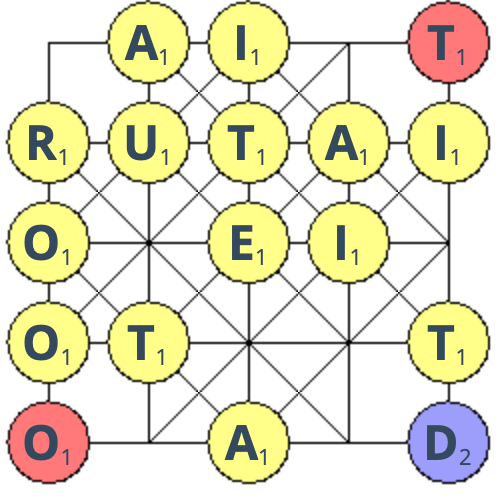
Now is possible to connect tiles across empty fields. For example word TATTOO - 54 points is correct.
18 - Havannah
A connection game by Christian Freeling.
Havannah is a two-player connection game played on a hexagonal board. Black moves first.
Rules
Players alternate placing one stone of their color on any empty cell. Stones do not move and are not captured.
After Black’s first move, White may play a swap move and take over Black’s first position.
Winning
A player wins immediately by making any one of these structures with connected stones of their color:
- Ring: a loop that surrounds at least one cell. The surrounded cell may be empty or occupied.
- Bridge: a connection between any two corner cells.
- Fork: a connection between any three sides. Corner cells do not count as sides for fork purposes.
Variants on Little Golem
Little Golem supports board sizes 4 through 10.
Links
19 - Hex
Hex invented in 1942
Hex was invented in 1942 by Danish inventor Piet Hein, and independently by the American mathematician John Nash in 1948.
You can play the game with paper and pencil on hexagonal paper.
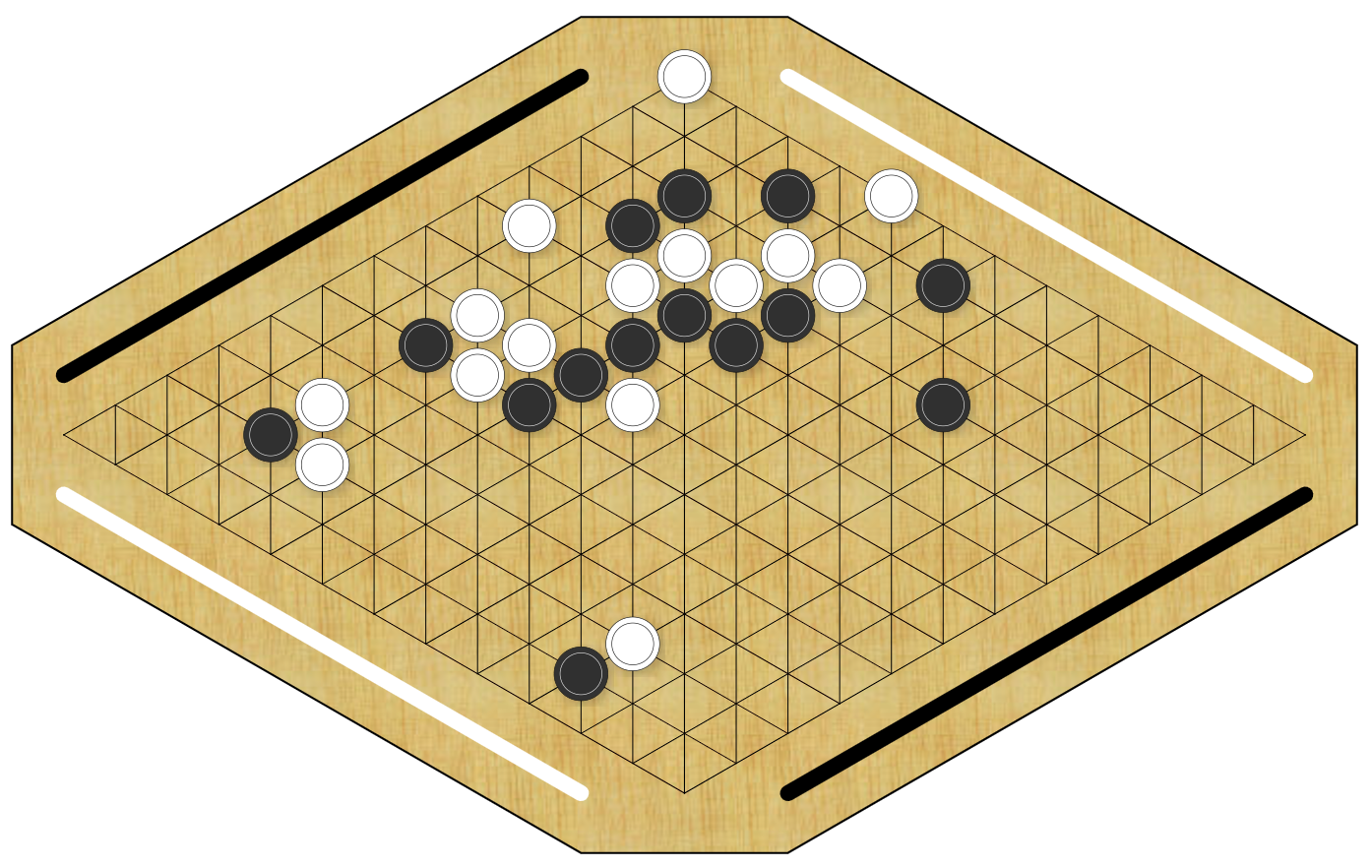
Rules
Each player is assigned a pair of opposite sides of the board which they must try to connect by taking turns placing a stone of their color on any empty space. Once placed, the stones cannot be moved or removed. A player wins when he successfully connects his sides by a chain of adjacent stones. Due to the topology of the game board, draws in Hex are impossible.
In the picture, black has connected his two sides and is the winner of the game.
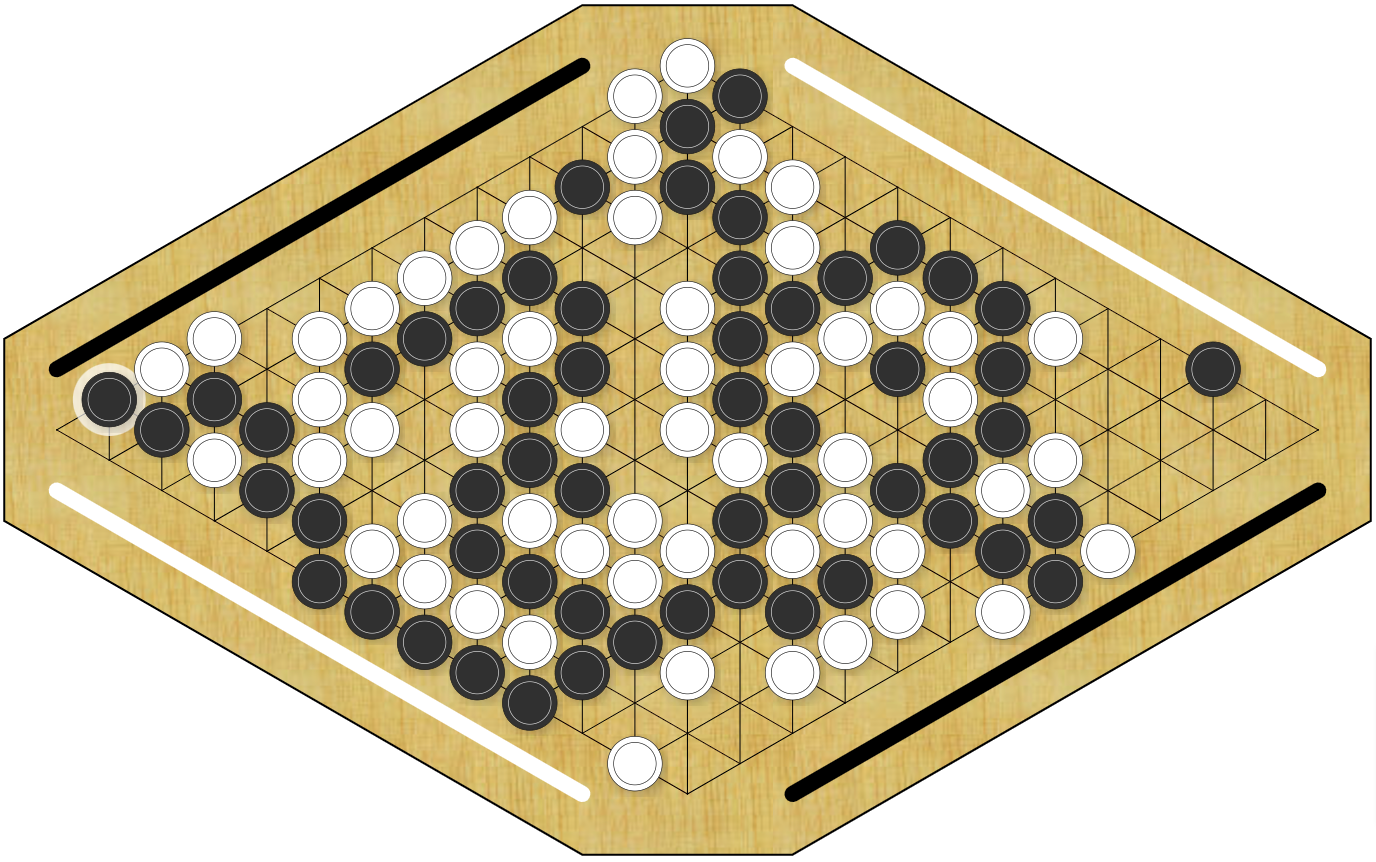
Swap move
After the first move, the second player can play a swap move and switch sides.
Variants
On Little Golem is Hex played on four board sizes: 11, 13, 15 and 19.
Links
- Online Puzzles - great site with interactive puzzles by Matthew Seymour and with A Strategy Guide
- Hex Strategy: Making the Right Connections - book written by Cameron Browne
- Wikipedia - history of the game, rules, variants.
- Hex on BGG
- Hex - hex game directly from Piet Hein’s site.
20 - Line of Action
Rules
Lines of Action (or LOA) is an abstract strategy board game for two players invented by Claude Soucie. The objective is to connect all of one’s pieces into a single group. The game was recommended by the Spiel des Jahres in 1988.
The object of the game is to bring all of one’s pieces together into a contiguous body so that they are connected vertically, horizontally or diagonally.
Movement
- Players alternate moves, with Black having the first move.
- Pieces move horizontally, vertically, or diagonally.
- A piece moves exactly as many spaces as there are pieces (both friendly and enemy) on the line in which it is moving.
- A piece may not jump over an enemy piece.
- A piece may jump over friendly pieces.
- A piece may land on a square occupied by an enemy piece, resulting in the latter’s capture and removal from the game.
- A player who is reduced to a single piece wins the game, because his pieces are by definition united. If a move results, due to a capture, in each player having all his pieces in a contiguous body, then either the player moving wins, or the game is a draw.
Initial position
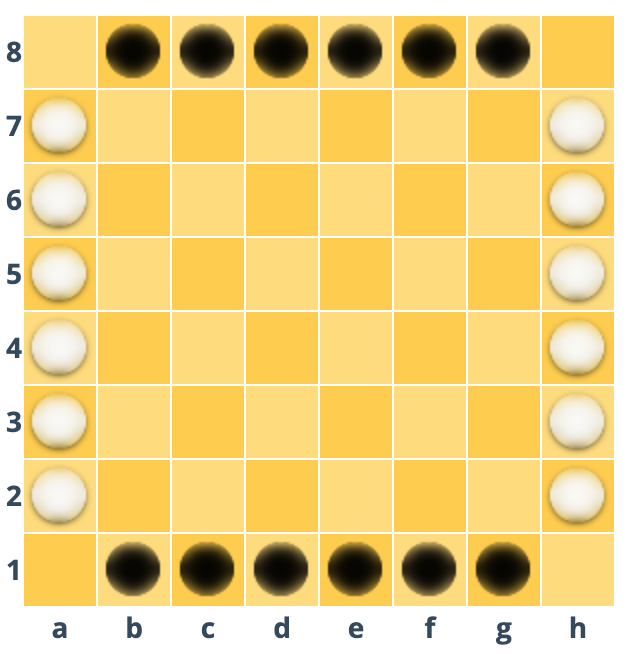
Final position
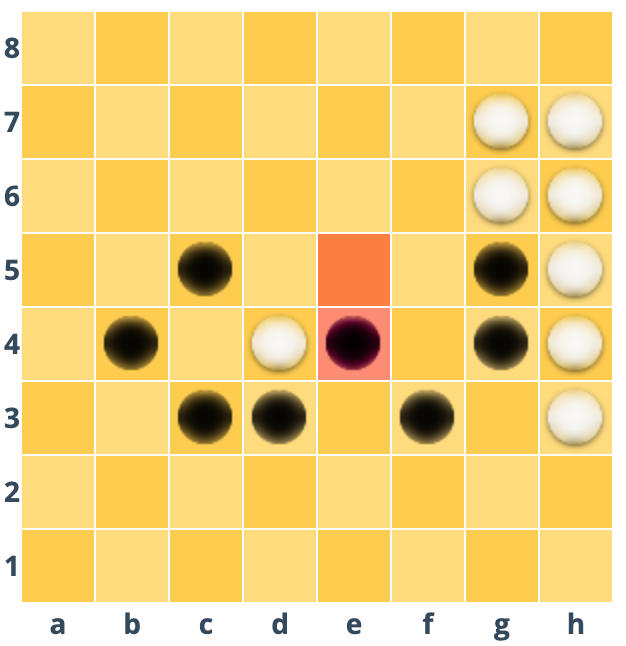
Variants
On Little Golem are implemented these versions of Line of Action.
Main variant
Standard variant played on 8x8.
Scramble
The variant has a different starting position.
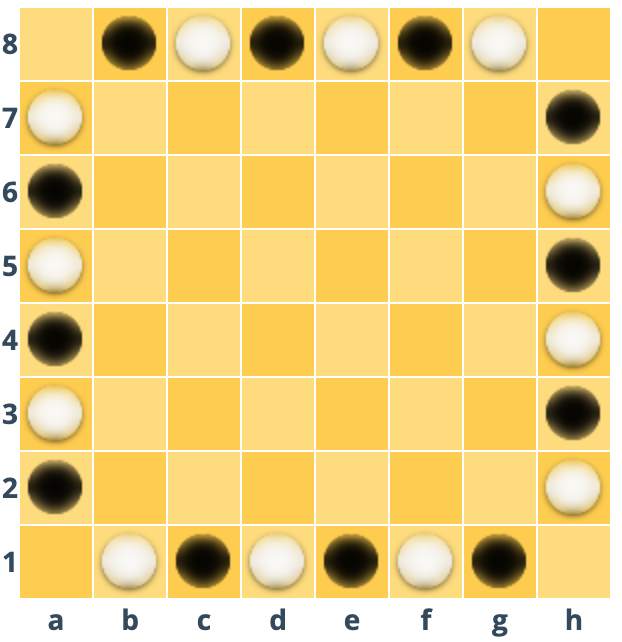
Quick
The variant has a different starting position.
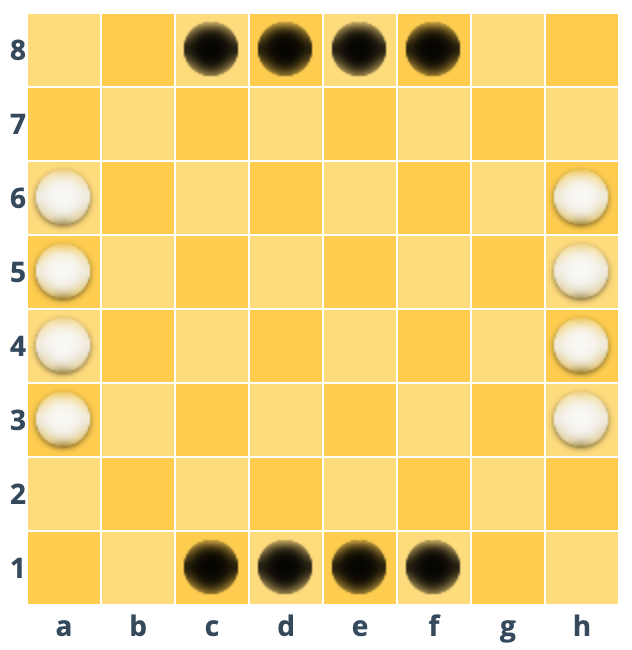
Blackhole
The variant is played on a 9x9 board. There is a black hole in the middle of the board where every stone disappears.
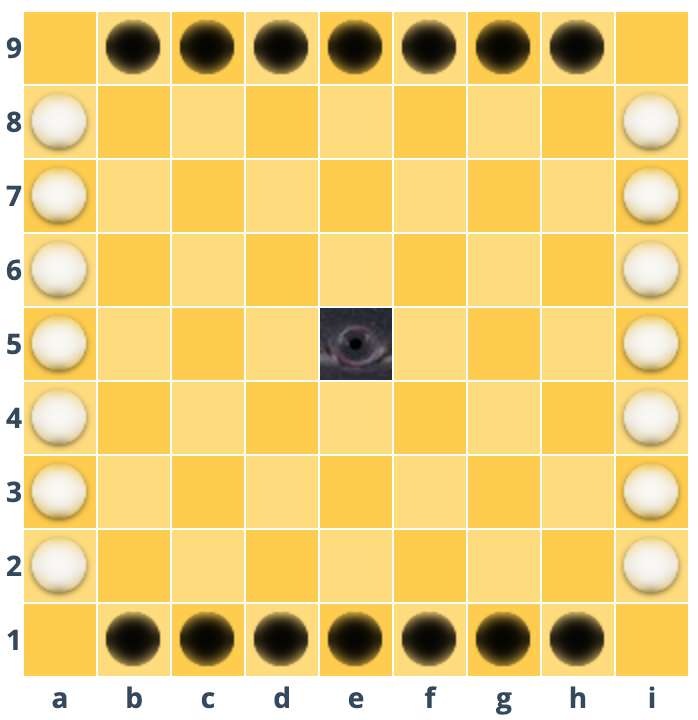
Links
21 - Lyngk
A GIPF Project stacking game with color claims.
LYNGK is a two-player abstract strategy game by Kris Burm. Little Golem plays
the Stack6 variant.
Setup
The board is filled with a random mix of colored stones. The colors are white, black, red, blue, green, and gray. Gray is neutral and cannot be claimed.
White moves first.
Color claims
During the game, each player may claim up to two non-gray colors. A color can be claimed by only one player.
A color claim is made together with a move or pass. Once you claim a color, stacks topped by that color are yours.
Movement
On a turn, move one stack in a straight line along the board lines to the first occupied stack in that direction. Empty spaces may be crossed; occupied stacks may not be jumped.
You may move:
- a stack topped by one of your claimed colors
- a stack topped by an unclaimed non-gray color
The moving stack is placed on top of the destination stack.
A combined stack may not contain the same non-gray color twice. Gray stones may repeat. On Little Golem, a stack may contain at most six stones.
If the moving stack is neutral, it may not be moved onto a taller stack.
Passing is allowed only when no legal move is available.
Winning and scoring
In Stack6, a player wins immediately by creating a stack of six stones topped
by one of their claimed colors.
Once four colors have been claimed and neither player has a legal move, the game is scored by stacks topped by claimed colors. Taller stacks are worth more:
| Height | Points |
|---|---|
| 1 | 1 |
| 2 | 10 |
| 3 | 100 |
| 4 | 1000 |
| 5 | 10000 |
The higher score wins. Equal scores are a draw.
Variant on Little Golem
Little Golem supports Stack6.
Links
22 - Morelli
A center-race abstract strategy game.
Morelli is a two-player abstract strategy game. Black moves first.
Setup
Little Golem uses a random setup on the edge of the board. Black and white stones are placed on paired opposite edge cells. The center starts empty and is the key square of the game.
Movement
Move one of your stones in a straight line toward the center. The move may be orthogonal or diagonal and may cross any number of empty cells, but it cannot jump over a stone.
A move must strictly reduce the stone’s distance from the center. A stone may not move onto the center square.
Capturing
After a move, opponent stones can be converted by custodian capture. If an opponent stone is adjacent to the moved stone and the next cell in the same line contains one of your stones, the opponent stone is turned to your color. This is checked in all eight directions.
The Morelli square
If a moved or converted stone completes a fourfold rotational set around the center, the center becomes marked for that player.
The game ends when the player to move has no legal move. The player who owns the center marker wins. If nobody owns the center, the game is a draw.
Variants on Little Golem
| Variant | Board |
|---|---|
| Size 9 | 9x9 |
| Size 11 | 11x11 |
| Size 13 | 13x13 |
| Size 31 | 31x31 |
Links
23 - Oski
Invented by Richard and Oskar Malaschitz in 2010
Rules
The game is very simple and can also be played as a paper and pencil game.
Board
Hexagonal board with 37 squares. The middle three squares can be of a different color.
Initial move
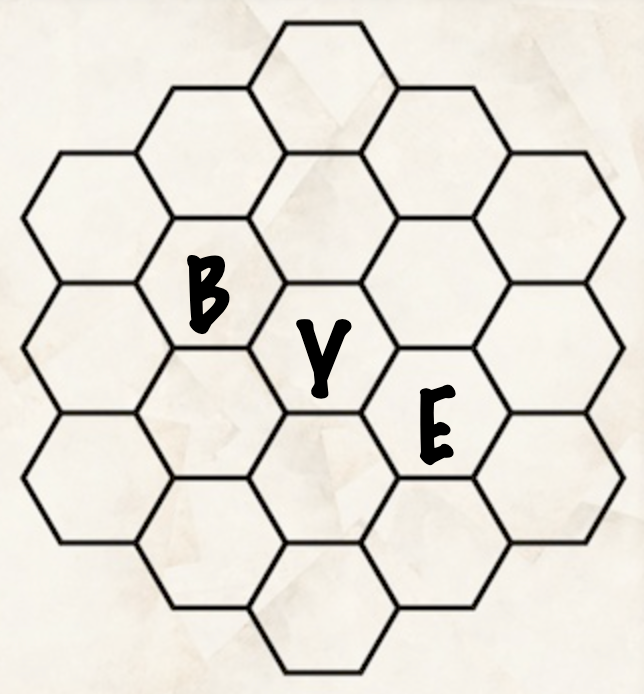
The player plays a three letter word into the marked square. Or the game is started with a random three letter word. This initial move is without points.
Next moves
The next player is in the game. For each move, the player puts a letter on the board and finds a word with that new letter. The length of the word is the score for that move. Example: move BYRE. The player scores four points. He now has 6.5 points. 4 points for words and 2.5 Komi.
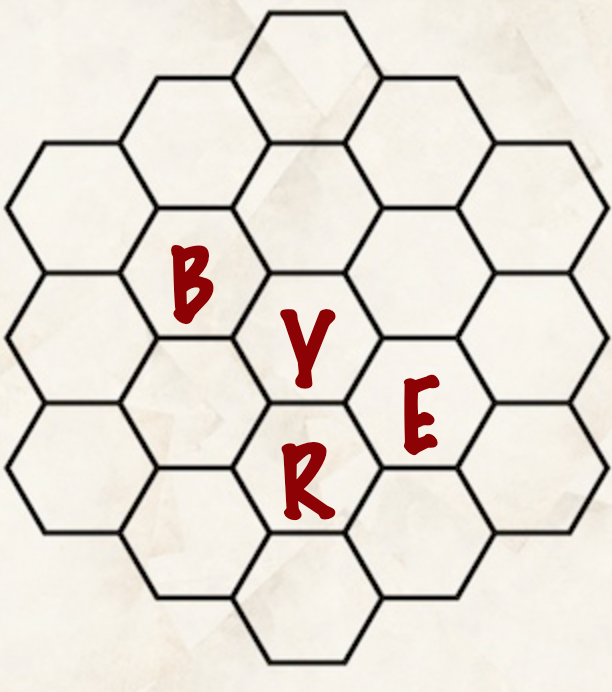
Next rules
- It is not possible to use already used words or words whose parts are already used. For example, if in the game the words BYE and BYRE were used, it is not possible to use the words ABYE, BYRES, FORBYE, GOODBYE, UPBYE, …
- The initial move does not count for points.
- The game ends when the board is full.
- The first player has 2.5 points komi.
Whole game example
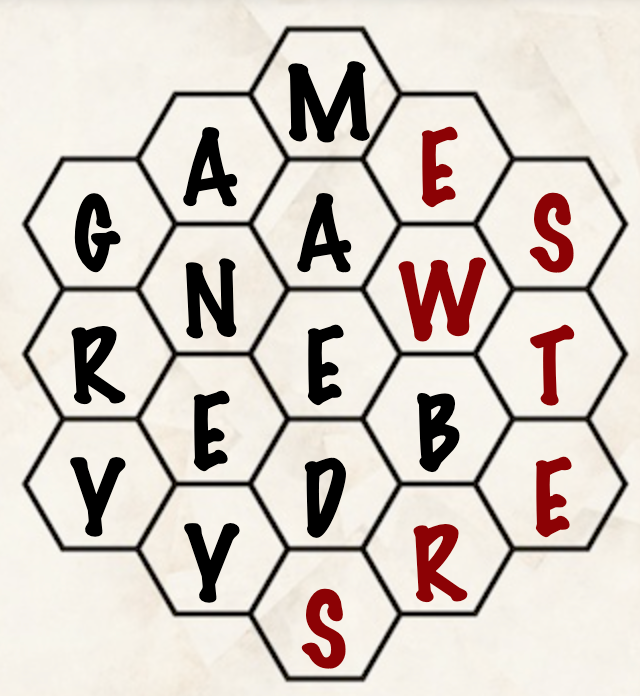
Initial move: NEB
| First player | Score | Second player | Score |
|---|---|---|---|
| BEEN | 6.5 | BEER | 4.0 |
| GREEN | 11.5 | AGREE | 9.0 |
| ANGRY | 16.5 | BEANERY | 16.0 |
| DEANERY | 23.5 | GREEDY | 22.0 |
| RENEW | 28.5 | TWEEDY | 28.0 |
| BETWEEN | 35.5 | TWEEDS | 34.0 |
| SWANG | 40.5 | NEWEST | 40.0 |
| GAMEST | 46.5 | WESTERS | 47.0 |
Variants
Game is played in 7 languages
24 - Polyomino
Game inspired with game Blokus Duo 2005
Polyomino is a simple board game with polyominoes. The game can be played as a paper-and-pencil game.
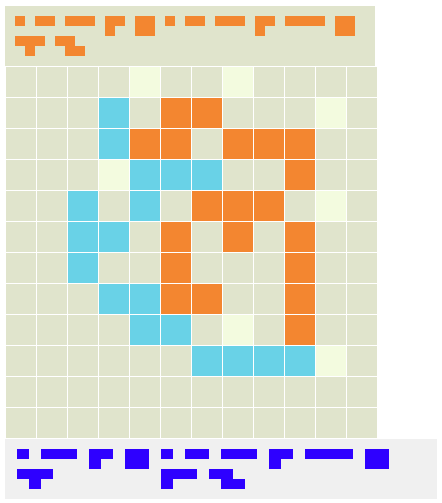
Rules
- Each player has a set of polyomino tiles, except in the hexa variant.
- The first player places a blue polyomino tile and an orange polyomino tile.
- The second player continues as the blue player or switches sides and the first player continue as the blue player.
- The next tile must be placed so that it touches at least one tile of the same color with its corners. The edges of tiles of the same color must not touch.
- If a player cannot place a tile, he passes.
- When there is no move, game is finished. Player with the most tiles wins the game.
Variants
Mini. Game on the board 8x8. Each player has 1 monomino, 1 domino, 2 trominos and 5 tetrominos.
Small. Game on the board 12x12. Each player has two sets from mini variant.
Penta. Game on the board 14x14. Each player has 1 monomino, 1 domino, 2 trominos, 5 tetrominos and 12 pentominoes.
Hexa. Game on the board 20x20. The game is played only with one common set of pieces: 1 monomino, 1 domino, 2 trominos, 5 tetrominos, 12 pentominos and 35 hexominos.
25 - QYPS
Game invented by Richard Malaschitz in 2016
Rules
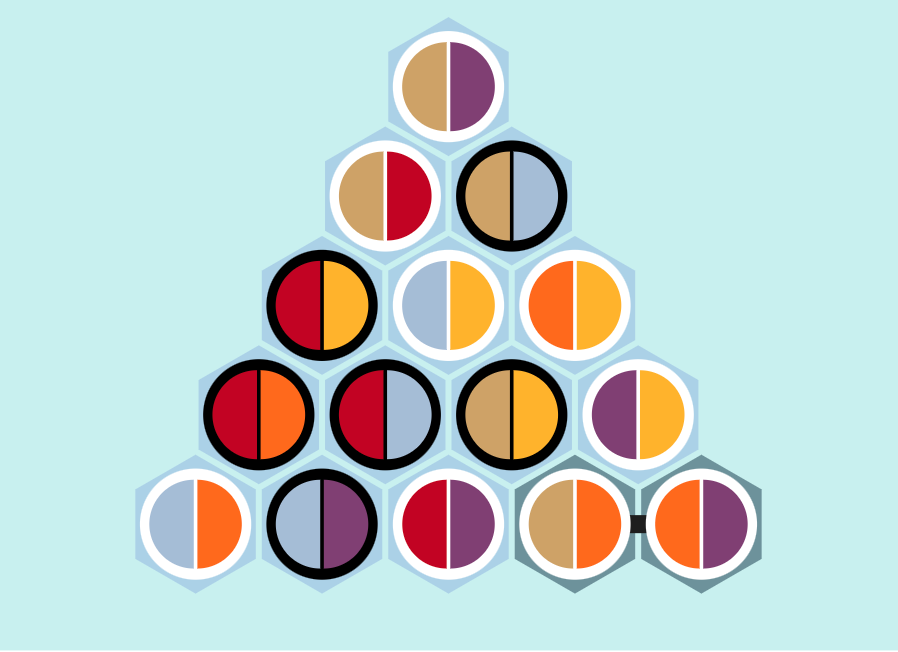
The game is played on a triangular board. The game is played with special stones. The stones have two sides (white and black). Each stone has two different colors. The game can be played on any board size:
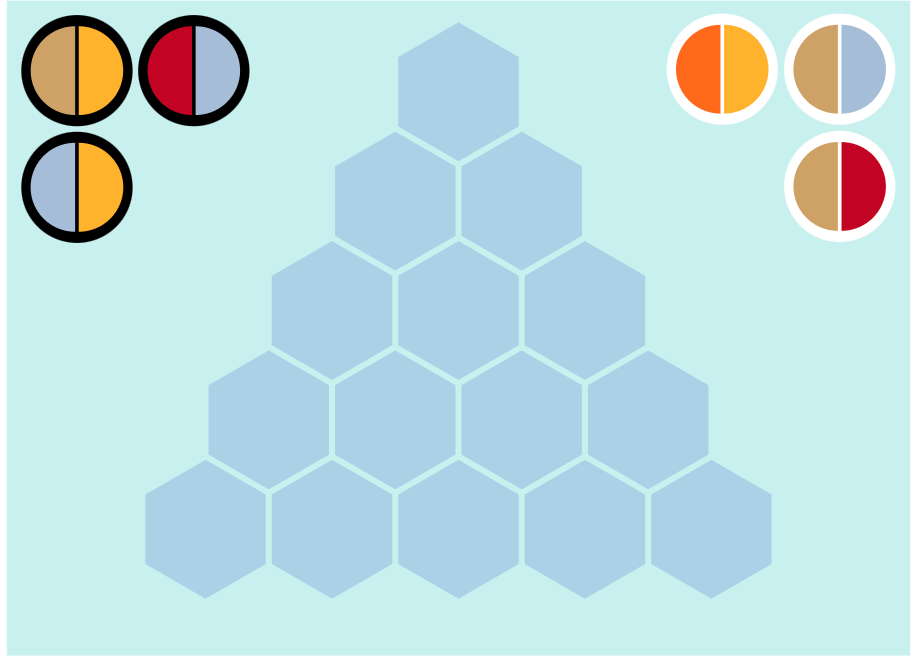
- Number of colors is size+1
- All color combinations are in game
- The number of stones is equal to the number of fields on the board
- The size of rack for player’s stones depends on size of board (3 for size 5, 5 for size 8)
- Each player has his own stones on rack. After the initial racks are dealt,
the opening choice is either
swapornoswap. - When it is a player’s turn, he can put several stones on the board. At least one stone must come from the player’s rack.
- The stones used in one turn must form one connected path. The path may use newly placed rack stones and stones already on the board.
- All stones used in the turn must share at least one common color.
- After the turn, both racks are refilled from the bag.
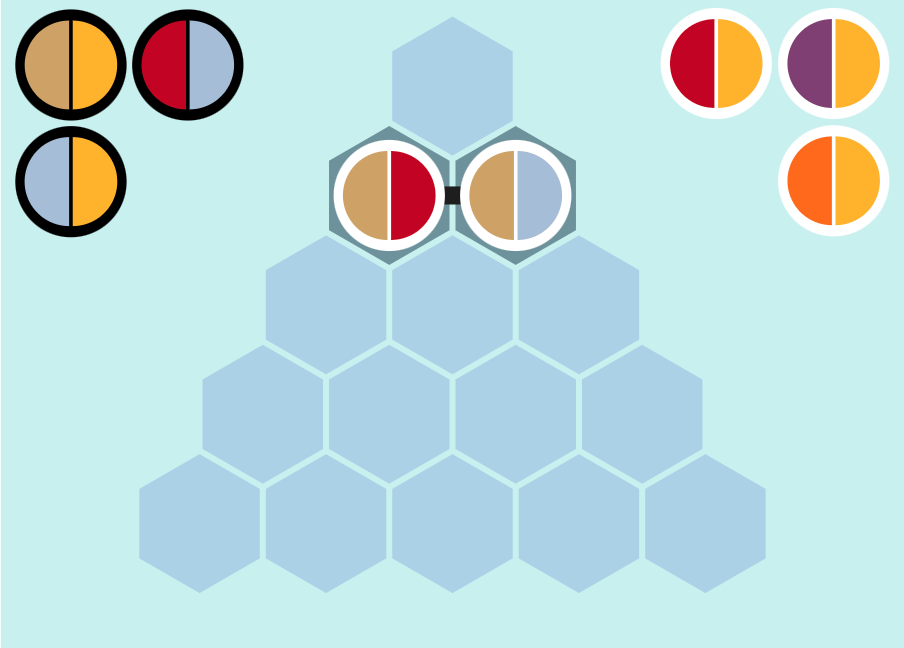
It is also possible to use stones already on the board. A player may explicitly flip one used opponent stone to their own side. If all stones used in the turn are in a straight line, then all opponent stones in that line are flipped to the moving player’s side.
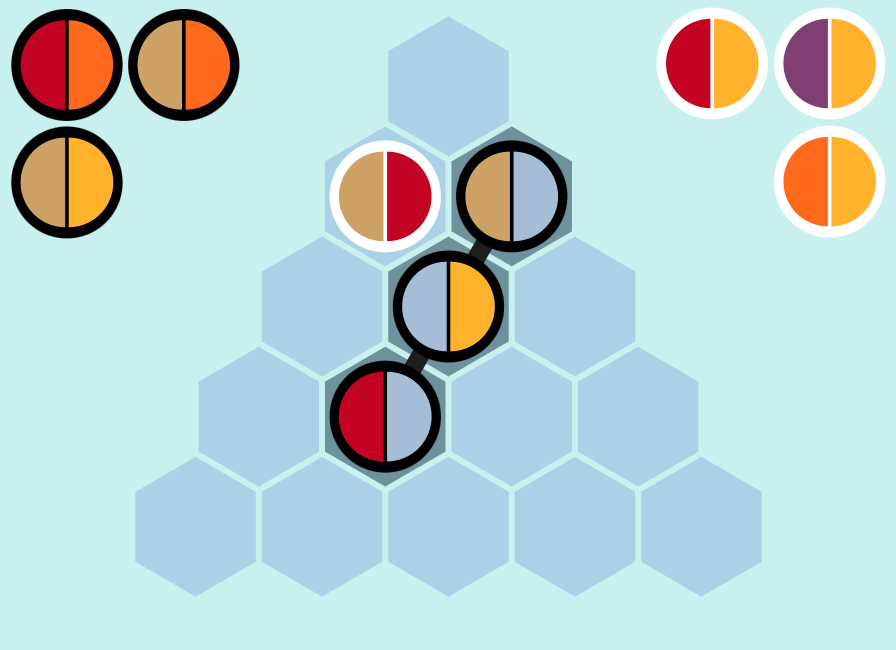
The game is evaluated when the board is full. The goal is to have a connected
group touching all three sides of the triangular board at the end of the game.
Little Golem marks a move that creates such a connection with a + in the
displayed move.
26 - Reversi
A disk-flipping strategy game played on several board sizes.
Reversi is a two-player strategy game played with black and white disks. Black moves first.
Rules
The game starts with four disks in the center of the board: two black and two white on opposite diagonals.
On each turn, a player places one disk of their color on an empty square. The move must outflank at least one straight line of opponent disks. A line is outflanked when the newly placed disk and another disk of the moving color enclose one or more opponent disks horizontally, vertically, or diagonally.
All outflanked opponent disks are flipped to the moving player’s color.
If a player has no legal move, they pass. Passing is only legal when no move is available. The game ends when neither player has a legal move.
The player with more disks on the board wins. If both players have the same number of disks, the game is a draw.
Variants on Little Golem
| Variant | Board |
|---|---|
| Size 6x6 | 6x6 |
| Size 8x8 | 8x8 |
| Size 10x10 | 10x10 |
| Size 12x12 | 12x12 |
Links
27 - Shogi
Japanese chess and several smaller Shogi variants.
Shogi is a chess-family game with drops: captured pieces can return to the board as your own pieces. Little Golem supports standard Shogi and several smaller variants.
Common rules
Sente moves first. Players alternate one move at a time.
On a turn you either:
- move one of your pieces on the board
- drop one captured piece from your hand onto an empty square
Pieces cannot move onto a square occupied by a friendly piece. A move may capture an opponent piece on the destination square. Captured pieces are added to the capturing player’s hand in their unpromoted form.
The usual goal is to checkmate the opponent’s royal piece. Fourfold repetition is a draw.
Forward always means toward the opponent’s side of the board.
Drops
Captured pieces in hand may be dropped onto empty squares, with these restrictions:
- A drop must not leave your own king in check.
- A pawn, lance, or Tori Shogi swallow may not be dropped on the last rank, where it would have no forward move.
- A knight may not be dropped on either of the last two ranks.
- In standard-piece variants, except Shogi 3x4, you may not drop an unpromoted pawn on a file where you already have an unpromoted pawn.
- A pawn drop that gives immediate checkmate is illegal in standard-piece variants, except Shogi 3x4.
- In Tori Shogi, a swallow drop that gives immediate checkmate is illegal.
- In Tori Shogi, a swallow may be dropped on a file only if you have fewer than two unpromoted swallows on that file before the drop.
Promotion
A piece may promote when a move starts or ends in the promotion zone. In the standard-piece variants, promotion is optional unless the piece would otherwise have no legal move on a later turn.
Tori Shogi is different: a swallow or falcon must promote whenever its normal move starts or ends in the two-rank promotion zone. A piece dropped into the zone does not promote until it makes a later normal move there.
Promotion is forced for:
- pawn and lance on the last rank
- knight on either of the last two ranks
Promotion zones on Little Golem:
| Variant | Board | Promotion zone |
|---|---|---|
| Shogi | 9x9 | last 3 ranks |
| Mini Shogi 5x5 | 5x5 | last rank |
| Tori Shogi | 7x7 | last 2 ranks |
| Shogi 3x4 | 3x4 | last rank |
| Shogi 5x6 | 5x6 | last 2 ranks |
| Shogi 5x6+ | 5x6 | last 2 ranks |
Supported variants
| Variant | Board | Initial material per player | Notes |
|---|---|---|---|
| Shogi | 9x9 | King, rook, bishop, 2 golds, 2 silvers, 2 knights, 2 lances, 9 pawns | Standard Shogi. |
| Mini Shogi 5x5 | 5x5 | King, gold, silver, bishop, rook, pawn | Standard piece moves on a small board. |
| Tori Shogi | 7x7 | Phoenix, 2 quails, falcon, 2 cranes, 8 swallows, 2 pheasants | Bird-themed Shogi variant. |
| Shogi 3x4 | 3x4 | Lion, giraffe, elephant, chick | Also known as Dobutsu or Animal Shogi. |
| Shogi 5x6 | 5x6 | King, 2 golds, 2 silvers, 3 pawns | Compact Shogi using standard Shogi movement. |
| Shogi 5x6+ | 5x6 | Same as Shogi 5x6, plus a lance and knight in hand at the start | Extra opening drops from the first move. |
Standard Shogi pieces
These pieces are used in Shogi, Mini Shogi, Shogi 5x6, and Shogi 5x6+.
| Piece | Symbol | Kanji | Movement | Promoted kanji | Promoted movement |
|---|---|---|---|---|---|
| King | K | 王 | One step in any direction. | - | Does not promote. |
| Rook | R | 飛 | Any number of squares orthogonally. | 龍 | Dragon king: rook movement plus one step diagonally. |
| Bishop | B | 角 | Any number of squares diagonally. | 馬 | Dragon horse: bishop movement plus one step orthogonally. |
| Gold general | G | 金 | One step forward, sideways, straight backward, or diagonally forward. | - | Does not promote. |
| Silver general | S | 銀 | One step forward, diagonally forward, or diagonally backward. | 全 | Moves as a gold general. |
| Knight | N | 桂 | Jumps two squares forward and one square sideways. | 圭 | Moves as a gold general. |
| Lance | L | 香 | Any number of squares straight forward. | 杏 | Moves as a gold general. |
| Pawn | P | 歩 | One step straight forward. | と | Moves as a gold general. |
Shogi 3x4 pieces
Shogi 3x4 uses animal pieces. The Little Golem move notation also uses the small symbols shown below.
| Piece | Symbol | App label | Movement | Promoted label | Promoted movement |
|---|---|---|---|---|---|
| Lion | K | 🦁 | One step in any direction. | - | Does not promote. |
| Giraffe | r | 🦒 | One step orthogonally. | - | Does not promote. |
| Elephant | b | 🐘 | One step diagonally. | - | Does not promote. |
| Chick | P | 🐥 | One step straight forward. | 🐔 | Hen: moves as a gold general. |
Shogi 3x4 also has a campmate rule: a lion wins by legally reaching the opponent’s back rank.
Tori Shogi pieces
| Piece | Symbol | Kanji | Movement | Promoted kanji | Promoted movement |
|---|---|---|---|---|---|
| Phoenix | K | 鵬 | One step in any direction. | - | Does not promote. |
| Left quail | Ql | 鶉 | Slides straight forward and on one backward diagonal; steps one square on the other backward diagonal. | - | Does not promote. |
| Right quail | Qr | 鶉 | Mirror image of the left quail. | - | Does not promote. |
| Falcon | Fa | 鷹 | One step forward, sideways, or diagonally. It has no straight-back step. | 鵰 | Eagle. |
| Eagle | +Fa | 鵰 | Falcon movement plus extra long moves: slides straight backward, and can continue along a forward diagonal when the adjacent diagonal square is empty. It can also move two squares backward diagonally when the adjacent diagonal square is empty. | - | Already promoted. |
| Crane | Cr | 鶴 | One step straight or diagonally forward, and one step straight or diagonally backward. It has no sideways move. | - | Does not promote. |
| Swallow | Sw | 燕 | One step straight forward. | 鴈 | Goose. |
| Goose | +Sw | 鴈 | Jumps two squares diagonally forward or two squares straight backward. | - | Already promoted. |
| Pheasant | Pt | 雉 | Jumps two squares straight forward, or steps one square diagonally backward. | - | Does not promote. |
Links
28 - Tumbleweed
Modern game invented by Mike Zapawa during COVID
Tumbleweed is a two-player game. It is played on a hexhex board and a sufficient supply of stacked checkers.
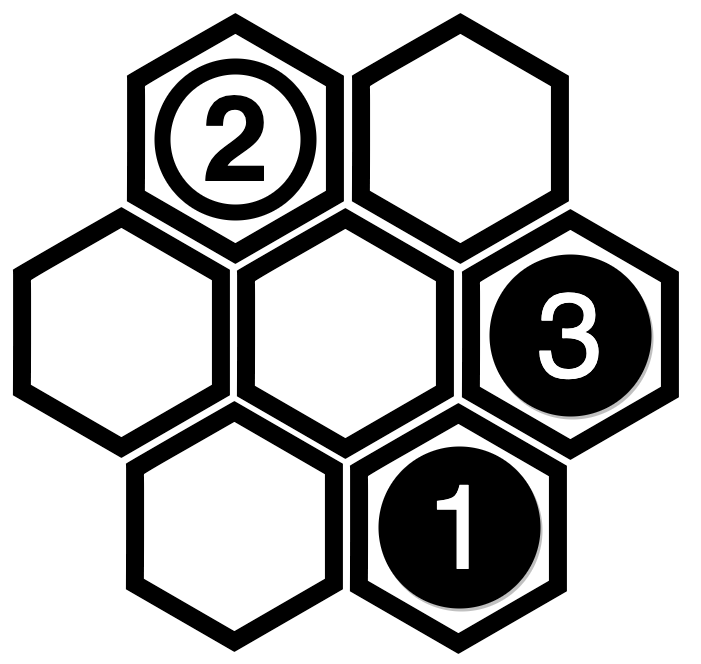
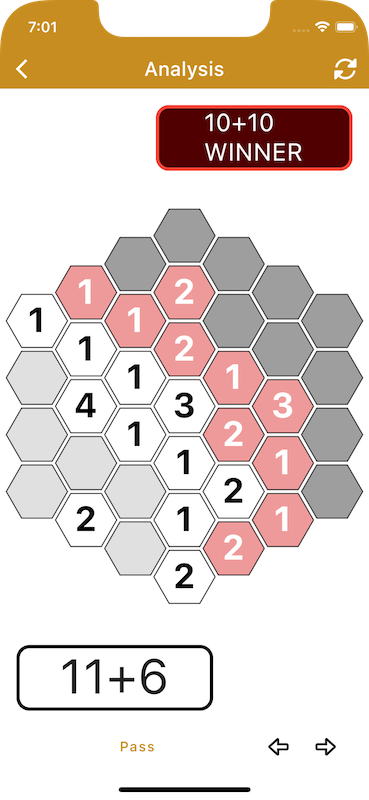
A stack can “see” a hex, when they are connected by a straight line, with no stacks in between. The players take turns placing stacks of their tokens on hexes that are seen by at least one friendly stack. The height of every newly-placed stack equals the number of your stacks that see the new stack. Replacing an existing stack with a new stack is possible, as long as the new stack is taller than the previous one. This works with opponent stacks (to capture), or your own stacks (to reinforce).
Before the game, the host sets up the board and the guest decides which side he wants to play.
On Little Golem the board starts with one neutral stack of height 2 in the
center. The first move places one black stack and one white stack on two empty
hexes. The second player may then either accept the colors or play swap, which
swaps the two starting colors.
After setup, a normal move places or replaces one stack for the player to move. The new stack height is the number of friendly stacks visible from that hex in the six hex directions. A move with zero friendly visibility is illegal. A stack may replace an existing stack only if the new stack is strictly taller.
The game ends after two successive passes. Little Golem scores occupied hexes plus empty hexes controlled by influence. An empty hex is controlled by the player with more visible stacks from that hex. The higher total wins; equal totals are a draw.
Links
The best article about Tumbleweed is on Abstract Games
Variants
On Little Golem are supported four sizes of board: 4,6,8 and 11.
29 - Slither
A dynamic two-player connection game by Corey L. Clark that also features an advanced variant.
Slither (by Corey L. Clark)
Slither is a dynamic connection game for two players, White and Black. Slither was conceived of as a simple solution to the problem of crosscuts or impasses in a square-board connection game. Advanced Slither was devised as a way to deal with some gameplay issues of Slither at high levels of play.
Neither version of Slither can end in a draw. Slither was designed by Corey L. Clark in 2010 and later revised by his invention of Advanced Slither in 2018.
For the new player, either version of Slither will open up a world of perplexing tactical and strategic possibilities, with a minimal set of rules.
Rules
Materials
Any square board as well as a supply of stones in two colors with enough stones for each player to cover half the board. You may also find something to designate a player’s edges.
Objective
The objective of Slither is to create an unbroken orthogonal chain of pieces connecting your designated board edges. Black aims to connect the top and bottom, and White aims to connect the left and right-hand sides.

Gameplay
The game is played on the intersections of the board. Starting with Black, on a turn, a player must place a stone of their color on an empty intersection of the board.
A player may also optionally move a stone of their color which is already on the board to an orthogonally or diagonally adjacent intersection. These actions may be performed in any order, but at the conclusion of the turn, any two diagonally adjacent stones of the player’s color must be orthogonally adjacent to a like-colored common stone.

Forced Passing
In the (rather unlikely) event that a player has no legal move on their turn, they must pass their turn. Passing is otherwise strictly prohibited.
Advanced Slither
Seasoned Slither players or even novices may want to try an advanced form of Slither which adds a condition on stone movement. This form of the game both adds a more static character to play—suggesting perhaps a greater strategic scope—and adds many tactical dynamics absent from the original. Advanced Slither, like its predecessor, cannot end in a draw.
Additional Rules
Movement:
In Advanced Slither, stones must always be moved prior to placement. A stone may only move if, prior to its movement, it is in a group (orthogonally contiguous set) of stones consisting of both players’ colors.

Pie Rule:
Due to its shown lack of efficacy in classic Slither, the Pie Rule appears here. This rule reduces the advantage of Black having an extra stone on the board. On their first turn, the White player may choose to play as Black instead of making their own move using the white pieces.
Strategy
A good strategy in Slither is to create flexible shapes for yourself while exploiting the inflexible shapes of your opponent.
Fig. 2 shows some examples of very inflexible shapes for Black which White is exploiting by threatening to cut through. Generally, inflexibility comes from having your stones spaced apart by one intersection. Stones a knight’s move apart are very flexible by contrast.
A good tactic in Slither is to split your movement and placement phase between two localities. If you can move a stone or place a stone in a position where it will take both a placement and movement by your opponent to counteract it, you’ll be able to use your other move to gain a local advantage somewhere else.
Advanced Slither Strategy
If you are playing Advanced Slither, there are also strategic concepts of:
- exploiting stones your opponent cannot make good use of, and
- attaching a large group of your own stones to them to “activate” these stones, allowing them to be moved in subsequent turns.
This is especially effective if you can pin these stones down so they cannot deactivate your stones by moving away from them.
Links
© 2021 Corey Lapinas Clark
30 - Sixfold
A two-player abstract game on 36 active cells with six colors, six shapes, and randomly selected board layouts.
Sixfold
Sixfold is a two-player abstract connection and grouping game played on exactly 36 active cells. There are 36 unique stones in the game, each formed by one of 6 colors and one of 6 shapes.
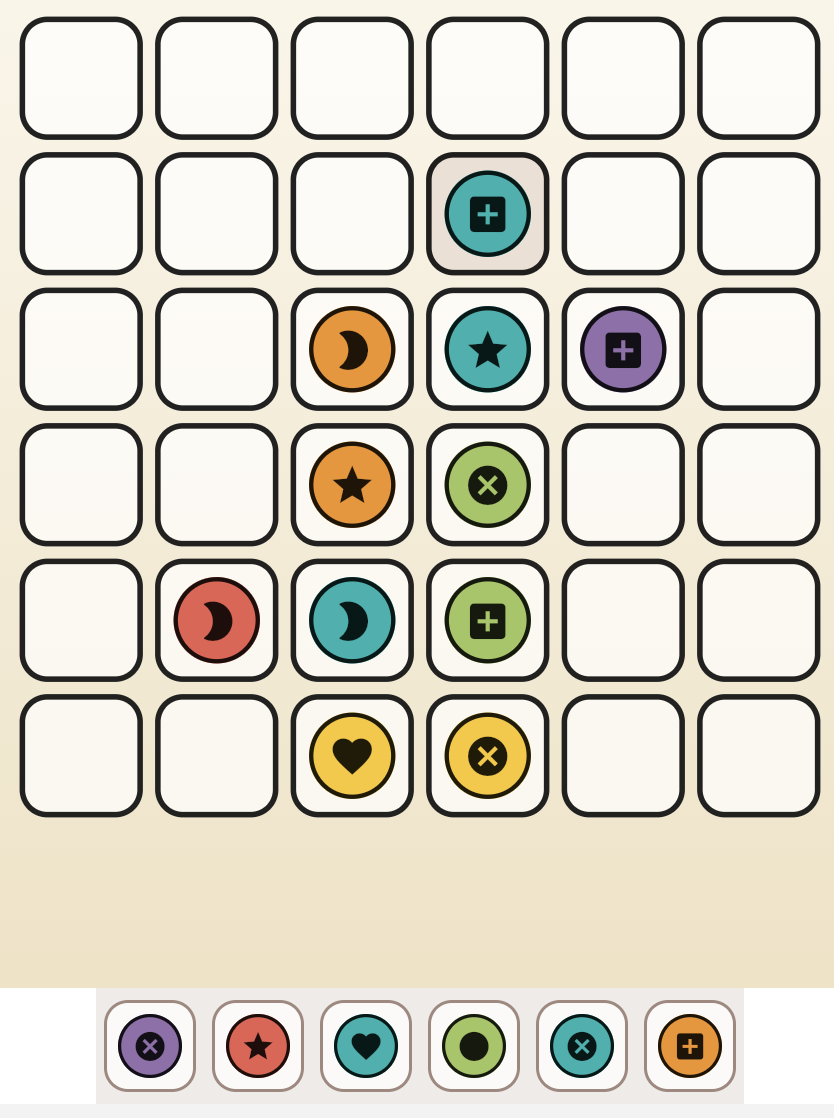
The two roles are:
ShapesColors
The Shapes player moves first.
Turn Structure
At the start of the game the board is empty and 6 random stones are revealed in the offer.
On each turn, a player:
- may optionally move one stone already on the board in a straight line along the current board geometry
- must place one offered stone onto an empty active cell
After placement, the offer is refilled back to 6 stones until the draw sequence is exhausted.
Random Board Layouts
The board layout is not a separate variant. It is selected randomly as part of the setup move.
Every Sixfold random setup uses one of these 4 layouts:
Square: 6x6 boardHex: hex-style adjacency in 6 directions, with the center cell removedCross: 7x7 board with the corner triads removed and the center cell removedTriangle: a hexagon-based isosceles triangular board with side length 8, similar in shape to the WYPS triangle boards
All four layouts contain exactly 36 active cells.
Movement
If a player chooses to move a stone before placing, the stone moves in a straight line until blocked by:
- the board edge
- an inactive cell
- another stone
On square and cross boards, movement uses 4 orthogonal directions.
On hex and triangle boards, movement uses 6 hex-style directions.
Scoring
Scoring is evaluated after the last stone is placed.
Shapes and Colors score independently.
For each connected group of size N, the score is:
N * (N - 1) / 2
The player with the higher total score wins. If both totals are equal, the game is a draw.
31 - Street soccer
StreetSoccer is a two-player football board game by Corné van Moorsel. Little Golem uses the legacy online flow from the Java implementation.
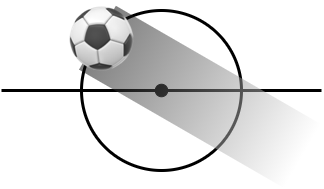
Setup
Yellow starts at the bottom goal and red starts at the top goal. Each player has five players on the field, including one keeper. At the beginning the keeper and one field player are already placed. The first phase is compressed into two setup moves:
- Yellow places three extra field players on legal empty fields.
- Red places three extra field players on legal empty fields.
- Each setup must place at least one player in the opponent’s half.
- Players may not be placed in the center circle.
- Only the keeper may occupy the two keeper fields in front of their own goal, except when the ball is there.
After both setup moves, Yellow kicks off. The kickoff die is generated from the two first virtual dice as the absolute difference between them, ignoring zero. The kickoff places only the ball; it cannot score a goal.
Turn
Each normal turn is driven by a deterministic die roll from 1 to 6. The player chooses one of their five pieces and moves it orthogonally by exactly the die value. A moving player may change direction between steps, but may not move through occupied fields.
If the moving player reaches the ball before using all die steps, the player stops on the ball and kicks it. The unused movement determines the kick length; Little Golem calculates all legal ball destinations.
Ball movement
The ball may move in the eight straight or diagonal directions. During one kick it may make one direction change: from straight to diagonal, or from diagonal to straight. The ball may not pass through an opponent.
If the ball reaches a friendly player, that player immediately redirects it: the remaining kick distance continues from that player’s field, again with a new choice of direction and one allowed direction change. This is how passes are handled.
A move must also leave the ball reachable for the opponent. Little Golem rejects moves that surround the ball so tightly that the opponent cannot reach it.
Goals and restart
A goal is scored when the ball crosses the opponent’s end line through the goal area. On Little Golem the goal mouth is the four central columns, and the last field before the end line must be one of the two fields directly in front of the goal.
After a goal, the next turn is a restart. The keeper is placed on one of the two keeper fields and then kicks the ball back into play. After-goal kicks use a die from 2 to 6.
End of game and tournament points
The normal game ends after 52 online moves. If the score is not tied, the leader wins. If the score is tied, sudden death begins and lasts at most 20 more moves. Any goal in sudden death wins immediately. If nobody scores in sudden death, the player who scored the last goal wins; if there was no goal, the game is drawn.
Tournament scoring follows the legacy StreetSoccer system:
- Normal-time win: 5 tournament points to the winner, 0 to the loser.
- Sudden-death win: 4 points to the winner, 1 to the loser.
- Undecided game with goals: 3 points to the player who scored last, 2 to the other player.
- Scoreless undecided game: 2 points for each player.
Move notation
The Java-compatible move notation is:
Pabcdeffor setup placement of three players.Bxyfor first kickoff.Mabcdfor a player-only move.Mabcd|Bxyfor a player move followed by a ball kick.Pxy|Buvfor an after-goal goalkeeper placement and ball kick.
Links
32 - Twixt
A connection game by Alex Randolph.
Twixt is a two-player connection game. On Little Golem it is played as Twixt PP.
Goal
White tries to connect the top and bottom sides of the board. Black tries to connect the left and right sides.
The first player to create a continuous chain of their own linked pegs between their two sides wins.
Rules
White moves first. On a turn, place one peg of your color on an empty hole.
You may not place a peg:
- on a corner
- on your opponent’s border rows
- on an occupied hole
After a peg is placed, Little Golem automatically creates links from that peg to friendly pegs a knight’s move away, if the new link does not cross an opponent link.
A link connects two friendly pegs separated by two holes in one direction and one hole in the perpendicular direction. Links form the connection network used for winning.
You may remove your own links as part of a move to rearrange your network. You may not remove opponent links.
Swap move
After White’s first move, Black may play a swap move. If Black swaps, the opening peg is mirrored across the main diagonal and becomes Black’s peg. White then moves next.
Variants on Little Golem
| Variant | Board |
|---|---|
| Size 24 | 24x24 |
| Size 30 | 30x30 |
| Size 48 | 48x48 |
Links
33 - Tzaar
A GIPF Project game about capturing and strengthening stacks.
TZAAR is a two-player abstract strategy game by Kris Burm. It is part of the GIPF Project.
Pieces
Each player has three visible piece types:
| Type | Count |
|---|---|
| Tzaar | 6 |
| Tzarra | 9 |
| Tott | 15 |
Stacks may contain any mix of types, but only the top piece type matters for the “must keep all three types” rule.
Rules
Little Golem uses the random setup variant. White makes the first move.
The first move of the game is a single capture. Every later turn has two steps:
- The first step must capture an opponent piece or stack.
- The second step may capture again, stack onto one of your own pieces or stacks, or pass.
All movement is in a straight line along the board lines. A piece or stack may move over any number of empty spaces, but it must stop on the first occupied space in that direction. It cannot jump over an occupied space.
To capture, move onto an opponent stack. A stack can capture only a stack of equal or lower height. The captured stack is removed and the moving stack keeps its height.
To strengthen, move onto one of your own stacks. The moving stack is placed on top and the heights are added. You may not strengthen in a way that hides your last visible piece of one of your three types.
Winning
You win if your opponent:
- has no visible piece of one of the three types
- cannot make the compulsory capture at the start of their turn
Variant on Little Golem
Little Golem supports the Random setup.
Links
34 - WYPS
WYPS invented by Richard and Alena Malaschitz in 2002. Final version of rules is from 2017.
Short story
The first version of the game was invented in 2002. The game was played with different rules on the Little Golem server. More than 20 variants and more than 800 players were played until the final rules were released.
Rules
WYPS is an abstract word game for two players.
Components
The game is played on triangular board with hexagonal squares. The rules are the same for all sizes of the board.
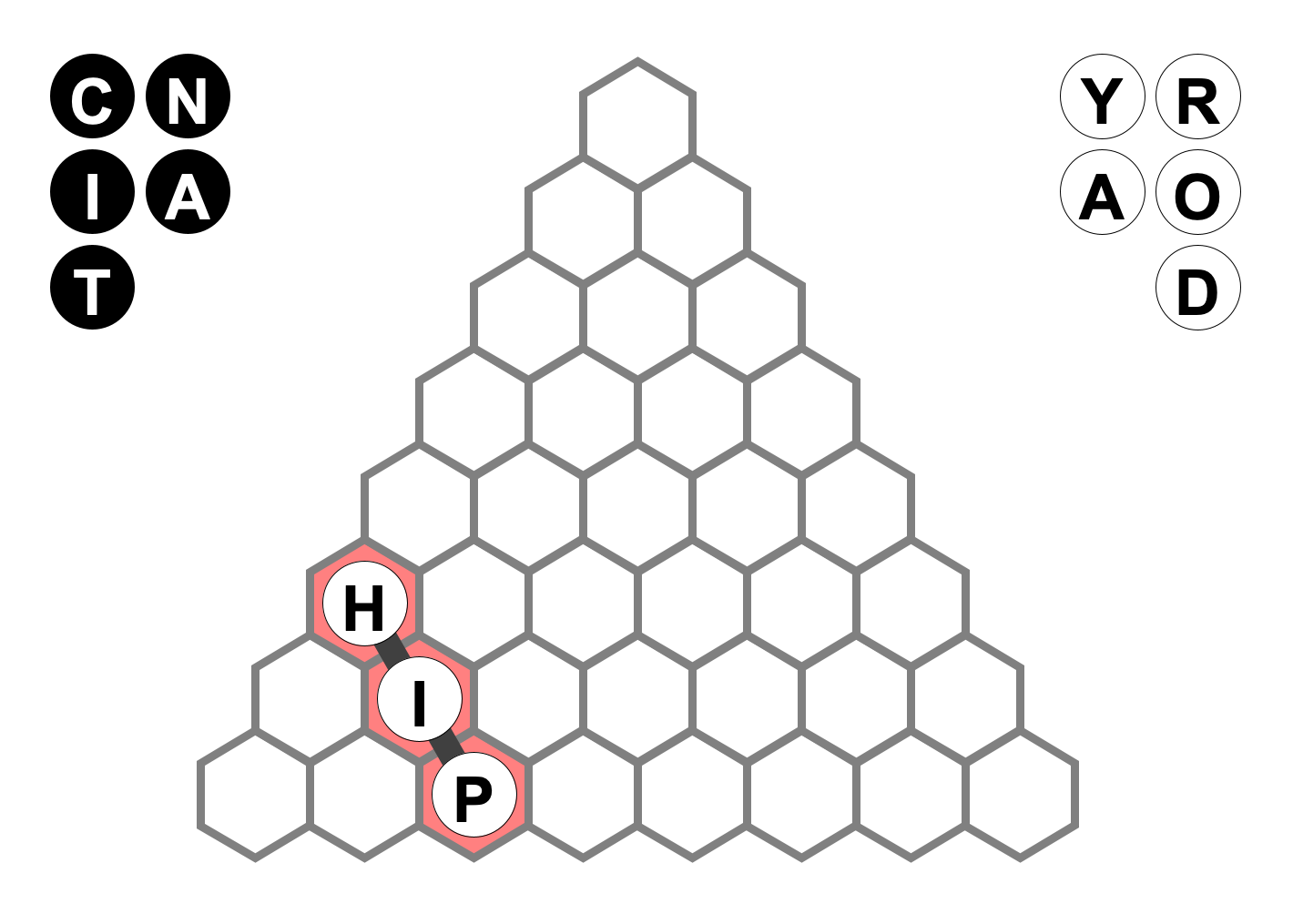
White’s first move is HIP
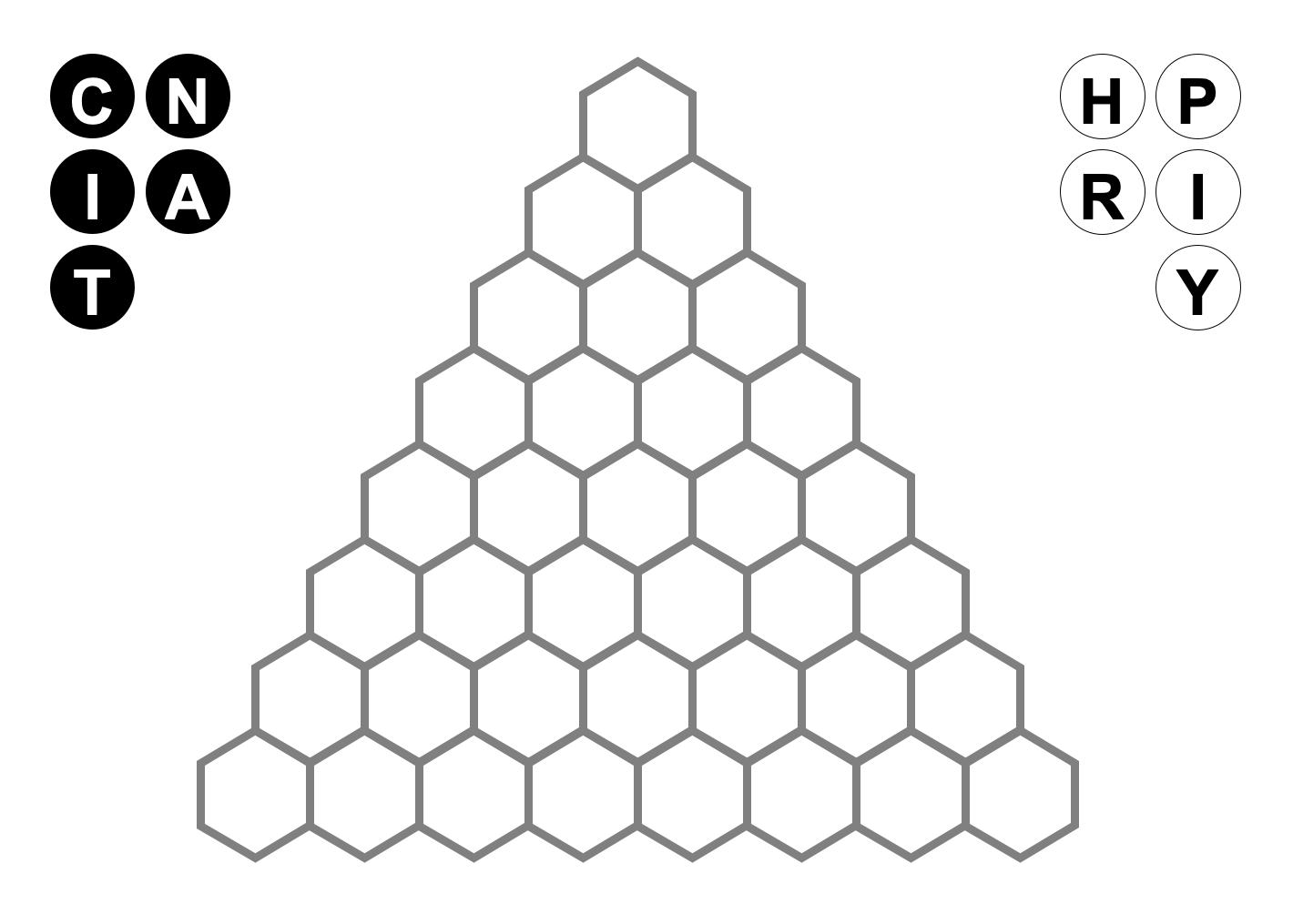
There are stones with letters. The stones have two different sides, each side representing one player. On each stone there is exactly one letter. The number of stones corresponds to the number of squares on the board (36 for size 8). At the beginning of the game, all the stones are in a bag.
Swap move
Each player draws five stones (five for size 8) from the bag. The black player can swap the stones between the players. All letters must always be swapped.
Gameplay
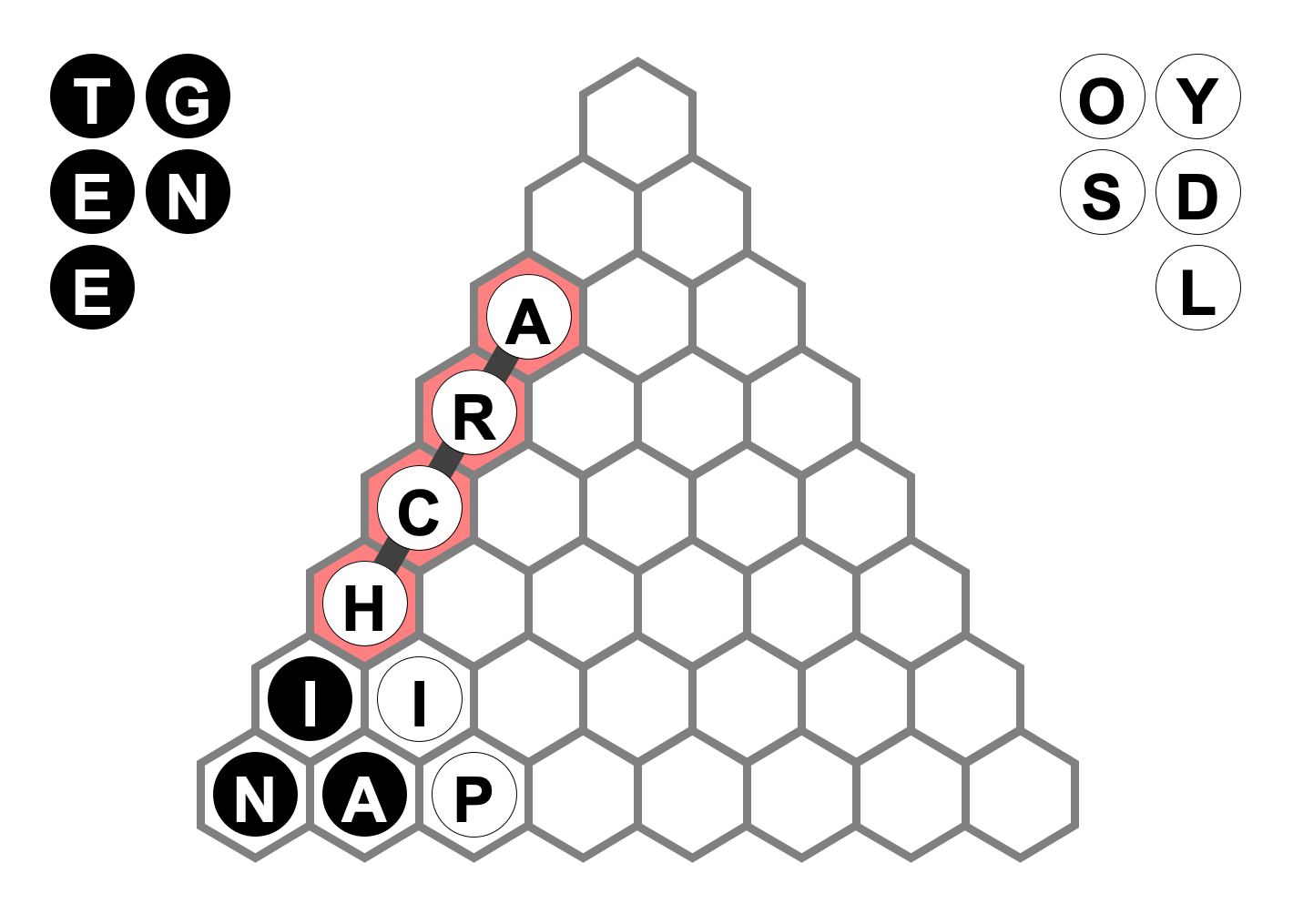
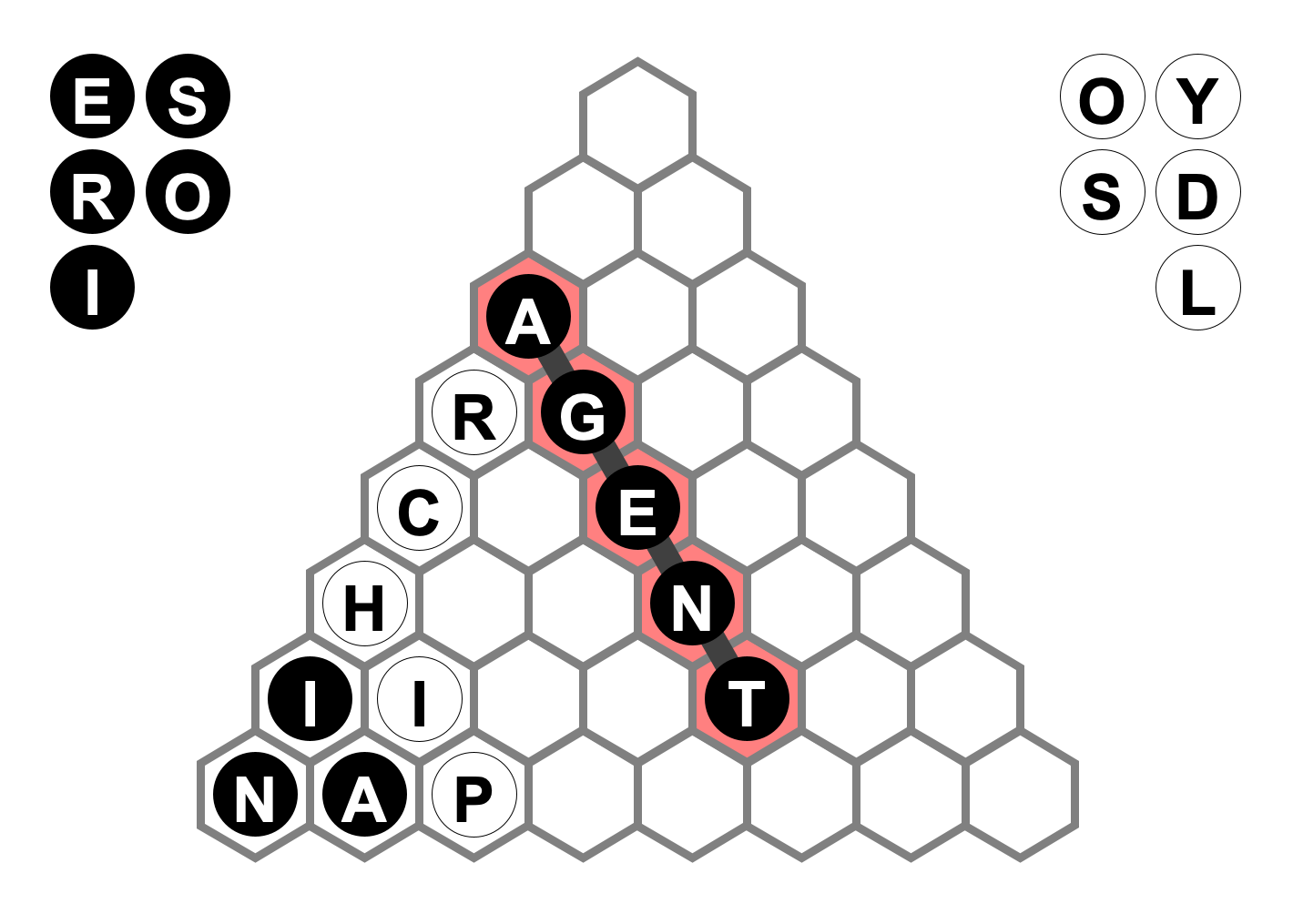
The players form words from their letters and from the letters on the board. If a player uses the opponent’s letters on the board, he turns one letter from these tiles to his own side. Instead of forming a word, it is possible to place only one letter from the rack on the board. At least one letter from the tray must be used in the turn. After the turn, up to seven letters are drawn from the tray (depending on the size of the board) if the bag is not empty. The first move is made by the white player. If the player forms the word in a straight line, she turns all used opponent’s letters to her own side.
Play continues with the next player.
Black player play move CHINA and turns over a stone.
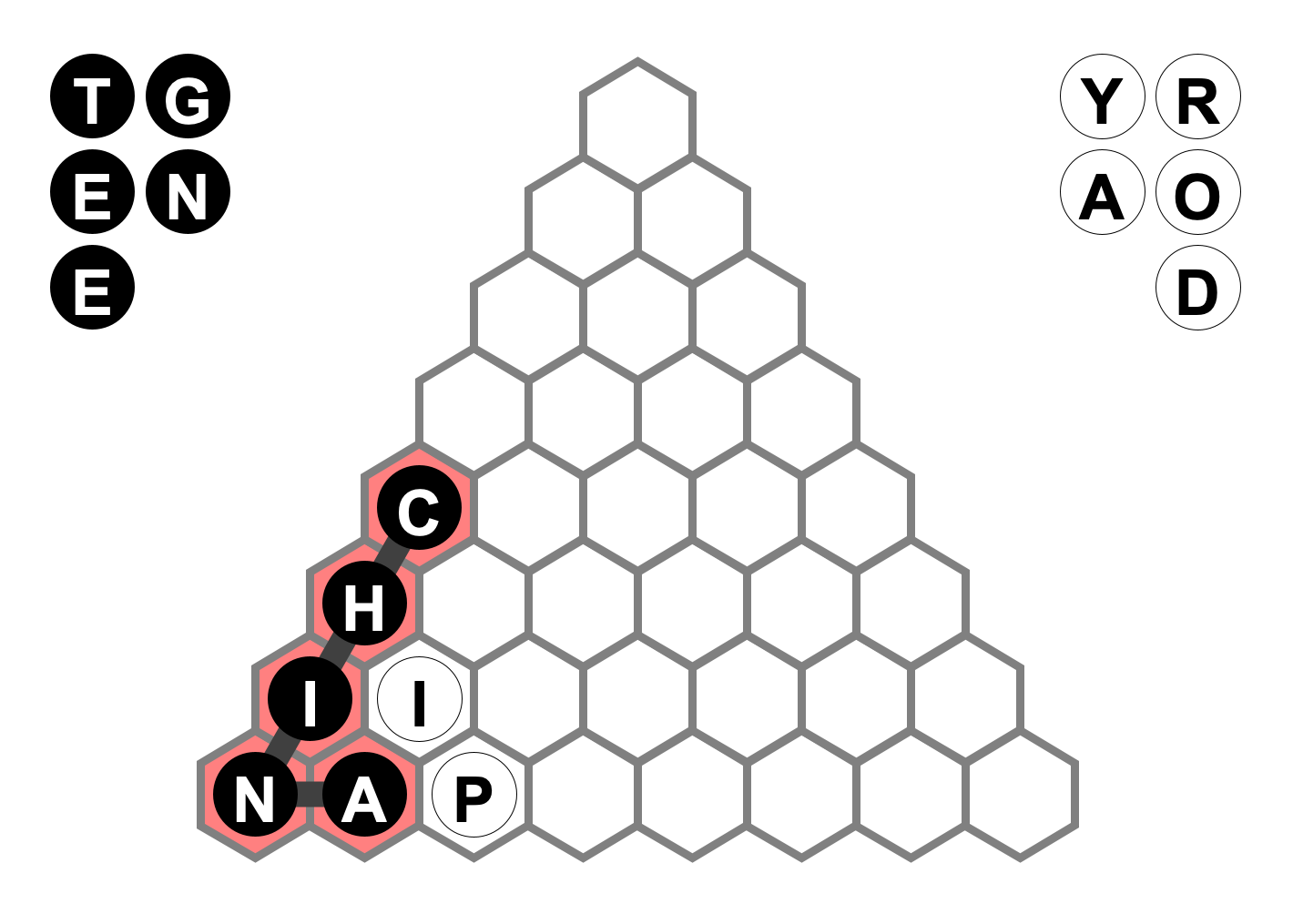
White play move ARCH in a straight line and turns over all used oponent’s stones.
Goal of a game
The object of the game is to form a group of stones connected to all three sides of the board.
White plays DOES and connects all three sides of the board. This move is called atari (attack). Black’s move must break this connection.
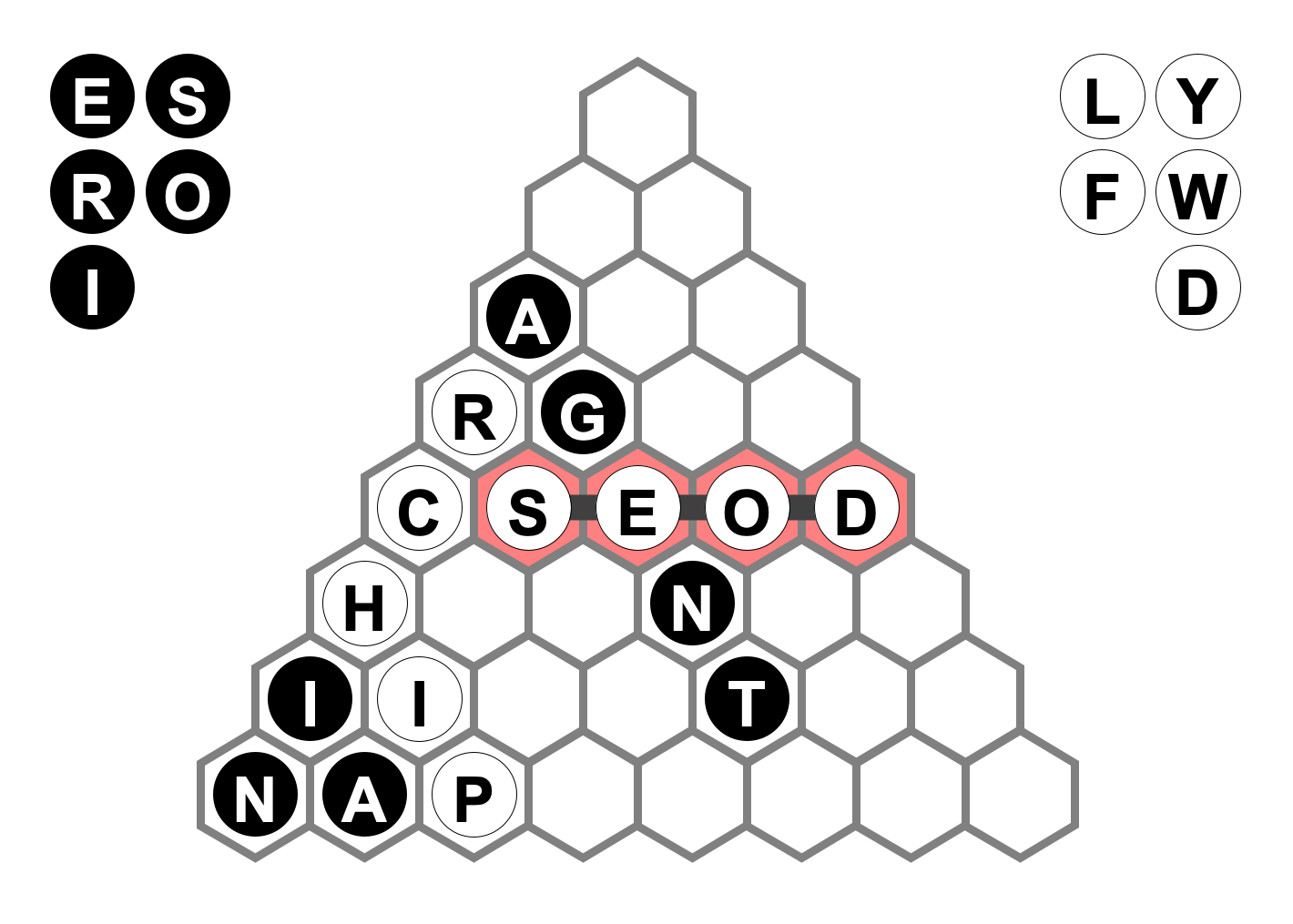
Black’s move SEARCH interrupts White’s atari. And this black move is also an atari.
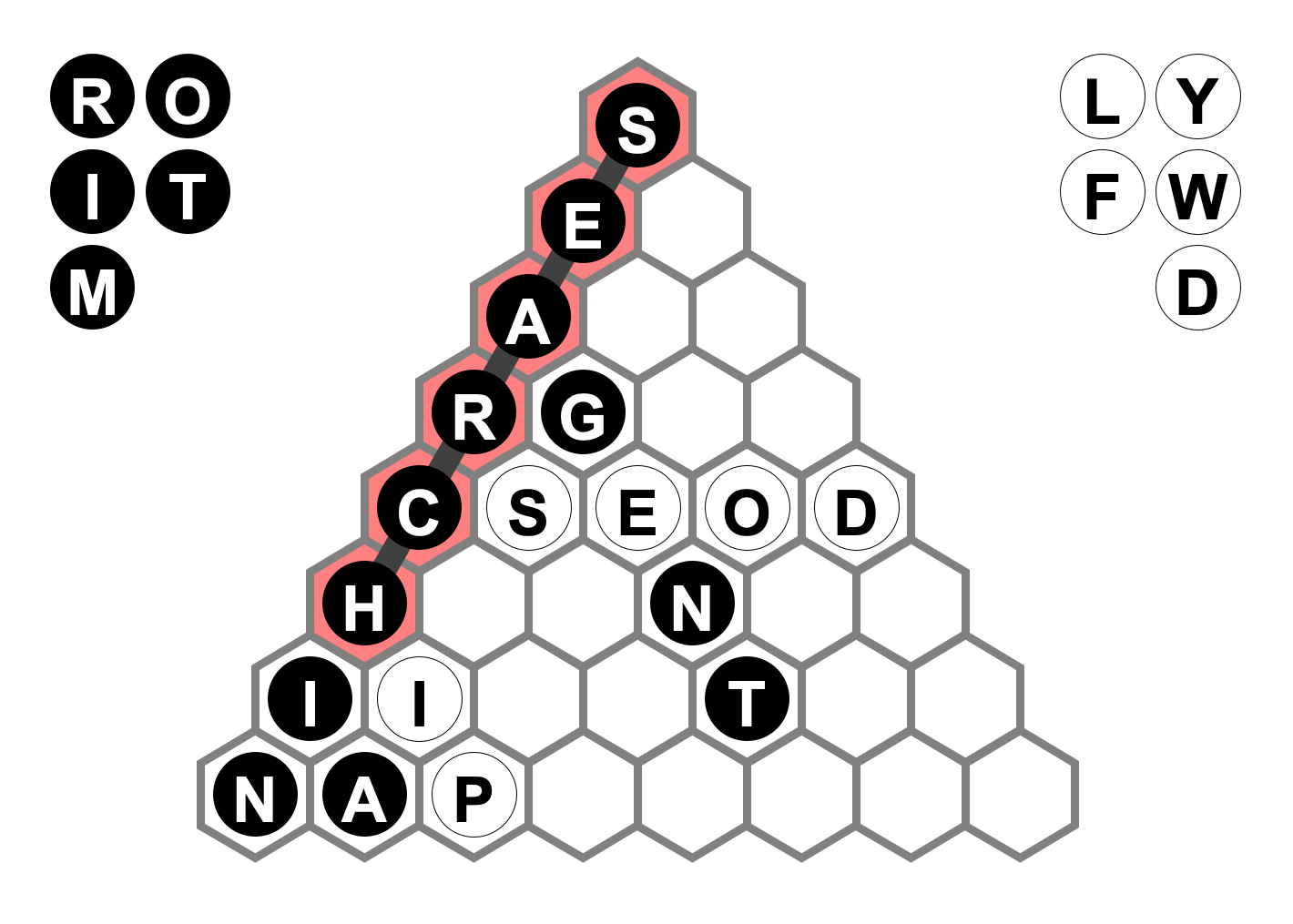
White plays the move CHILD. White used two letters from rack and two opponent’s stones. She can flip C or H to the white side. She decides to flip the letter H.
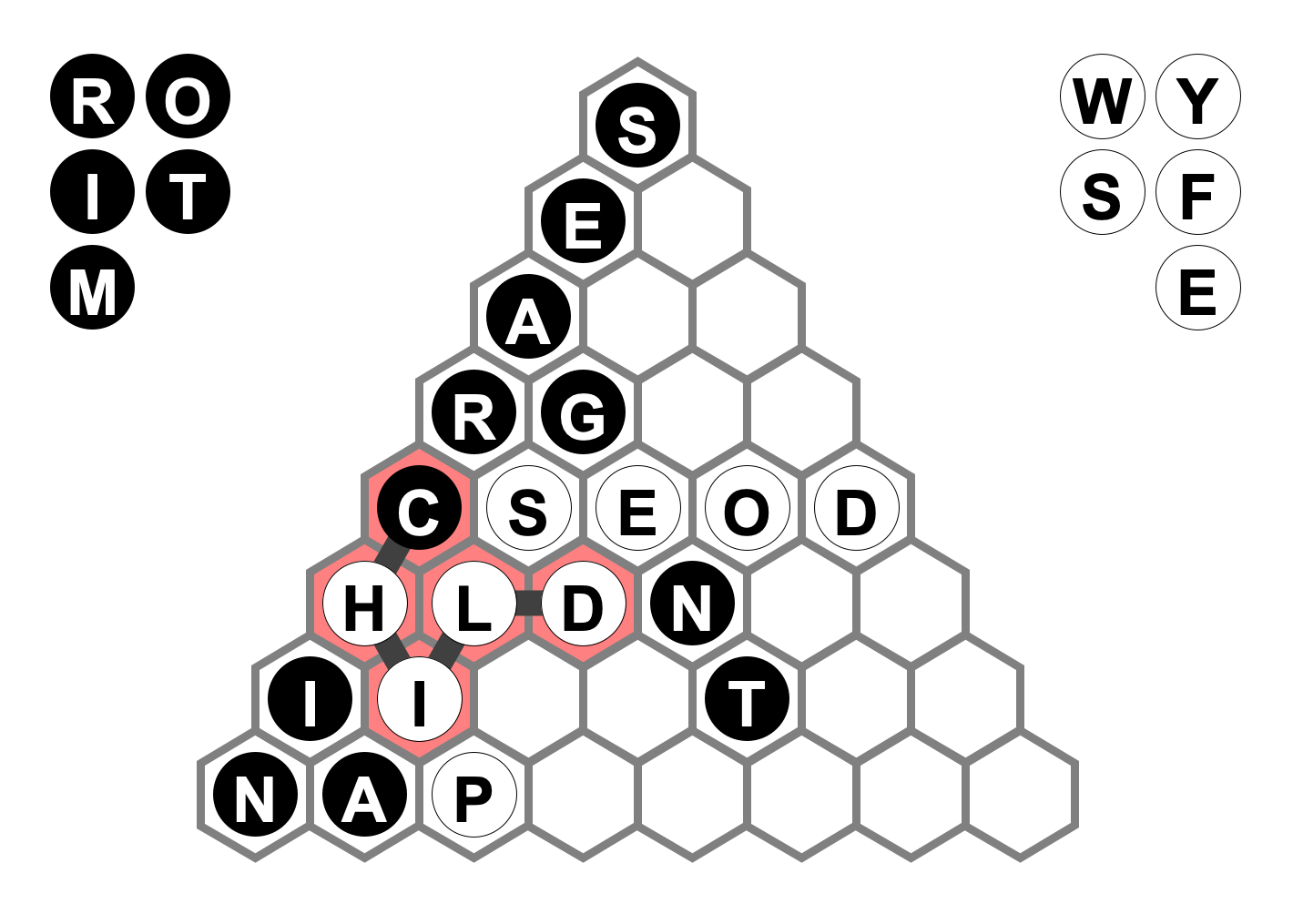
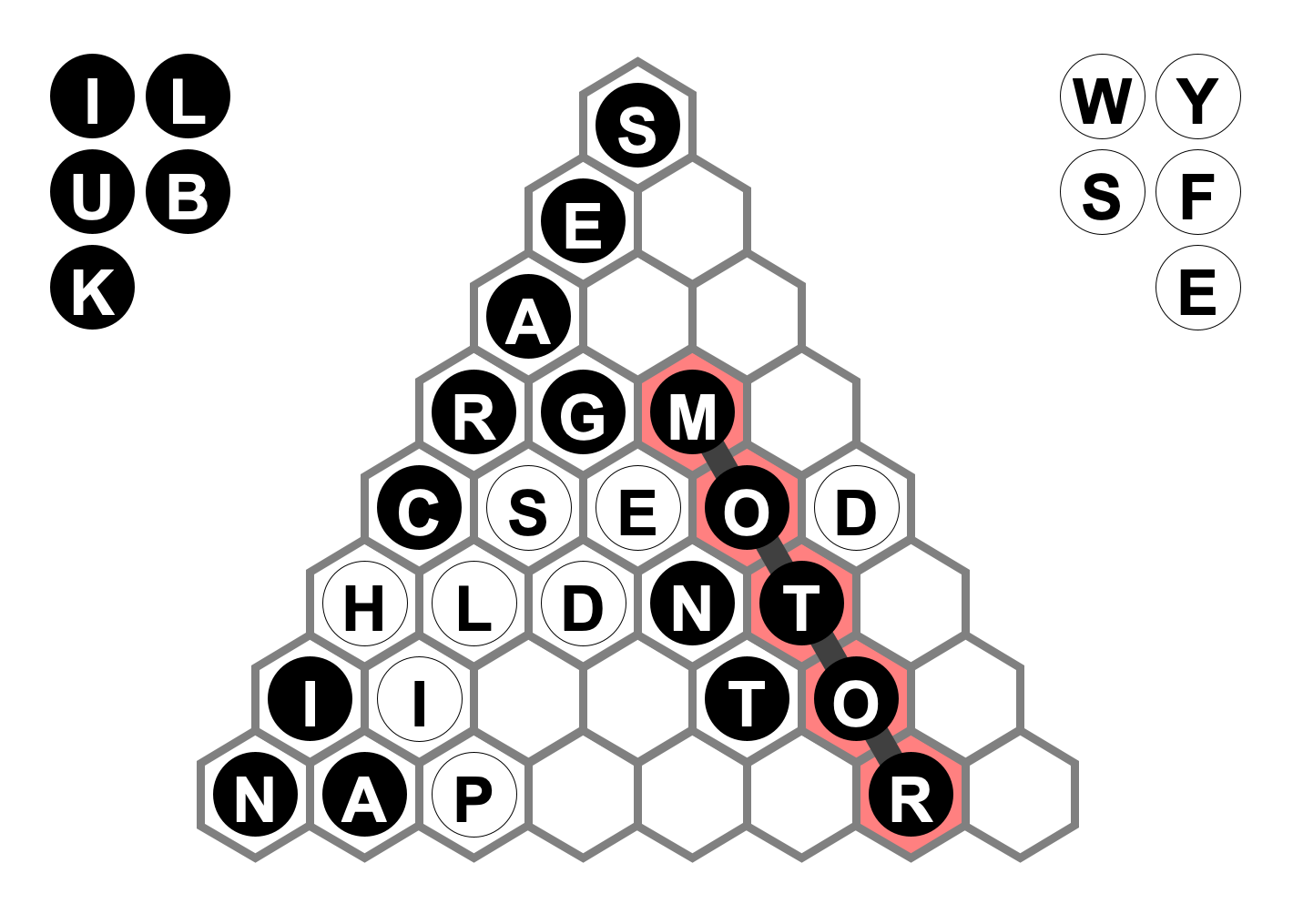
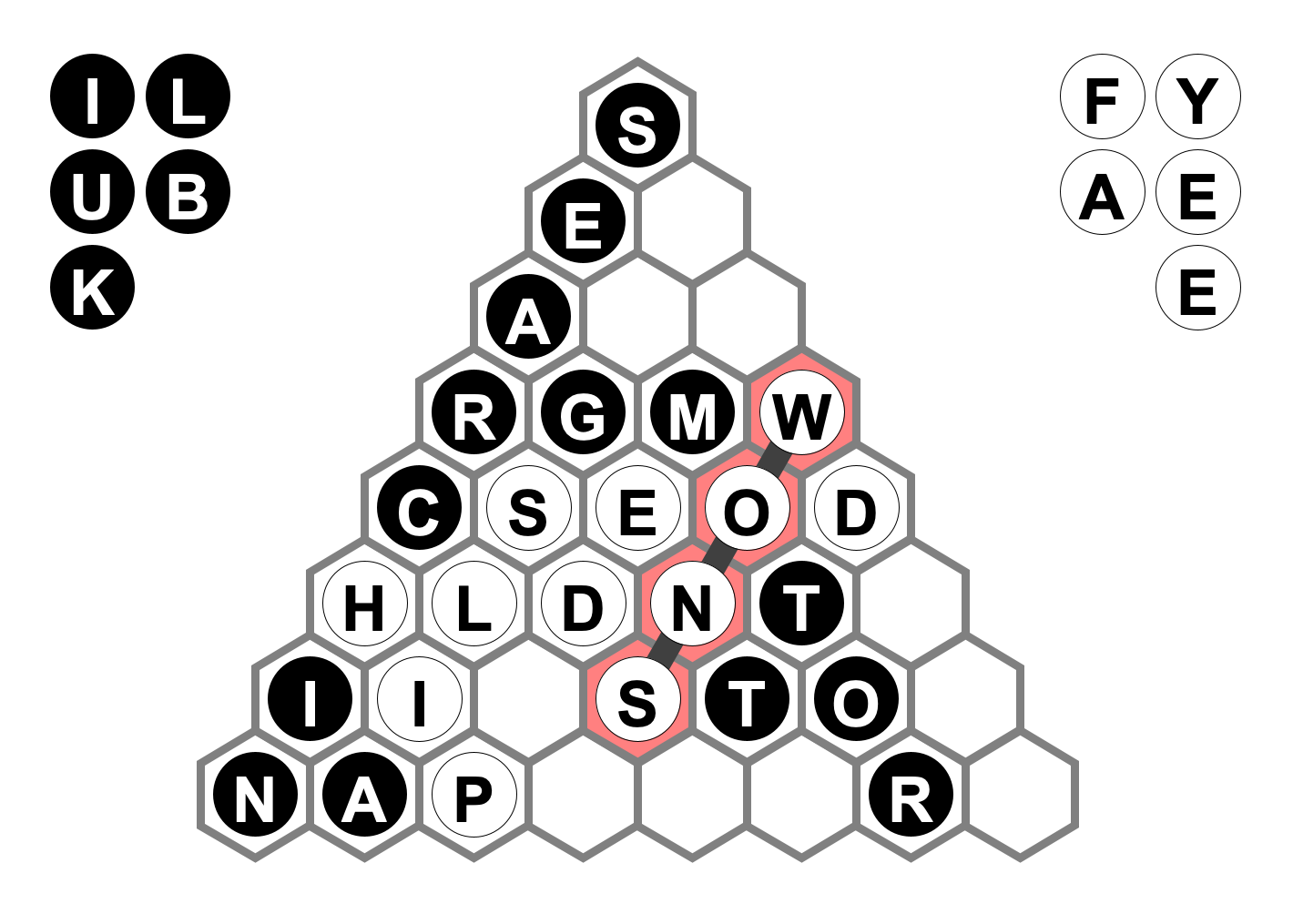
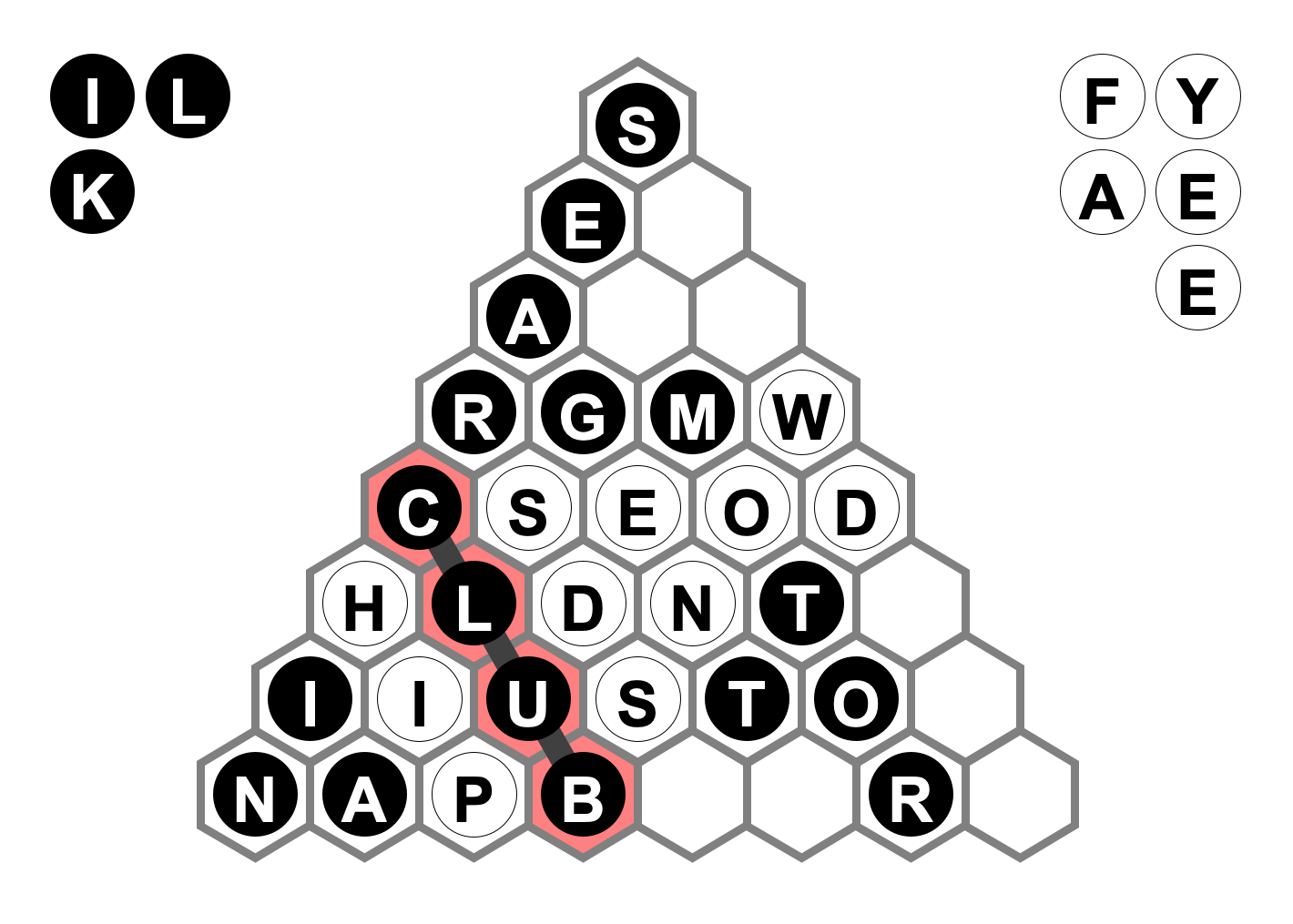
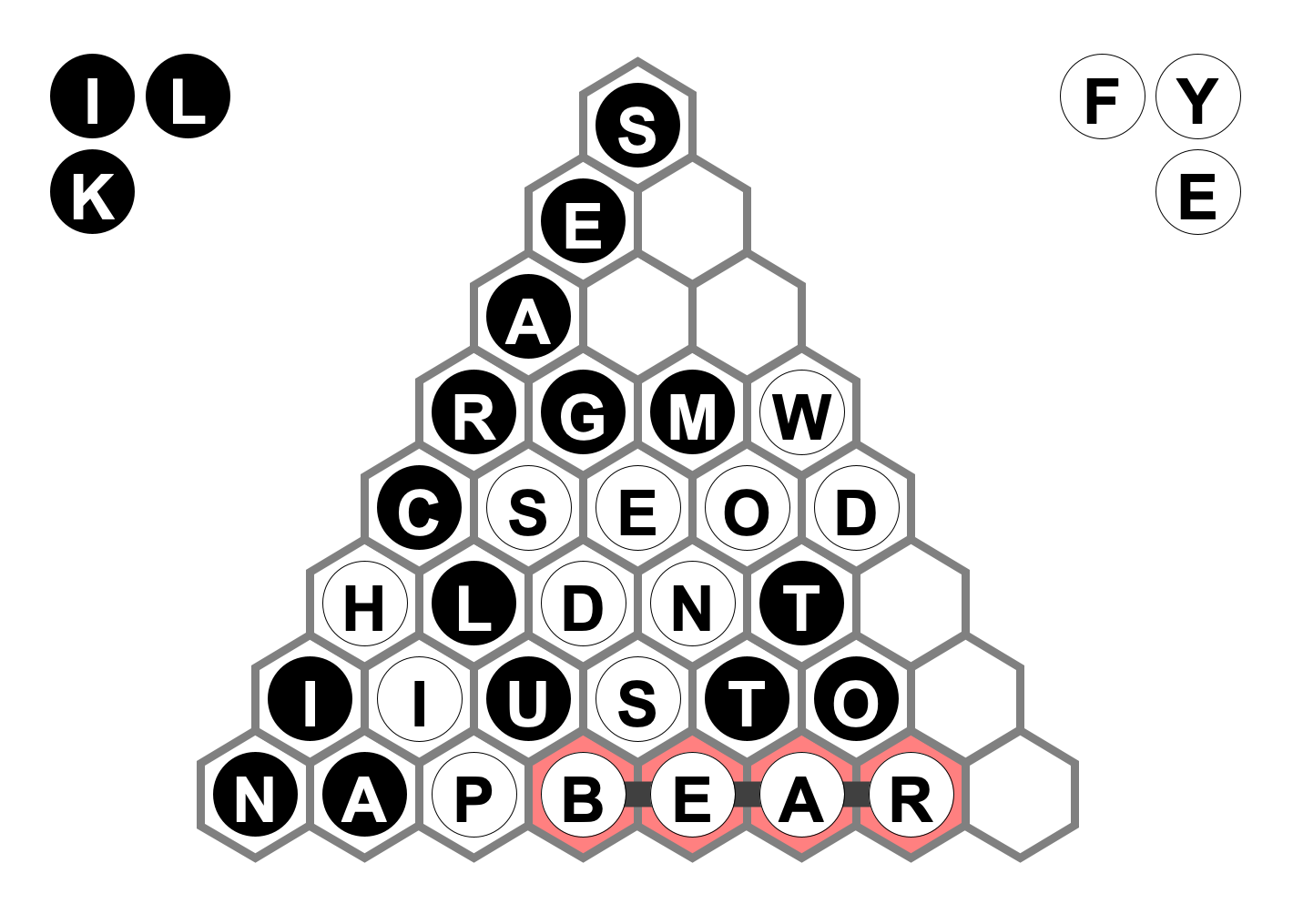
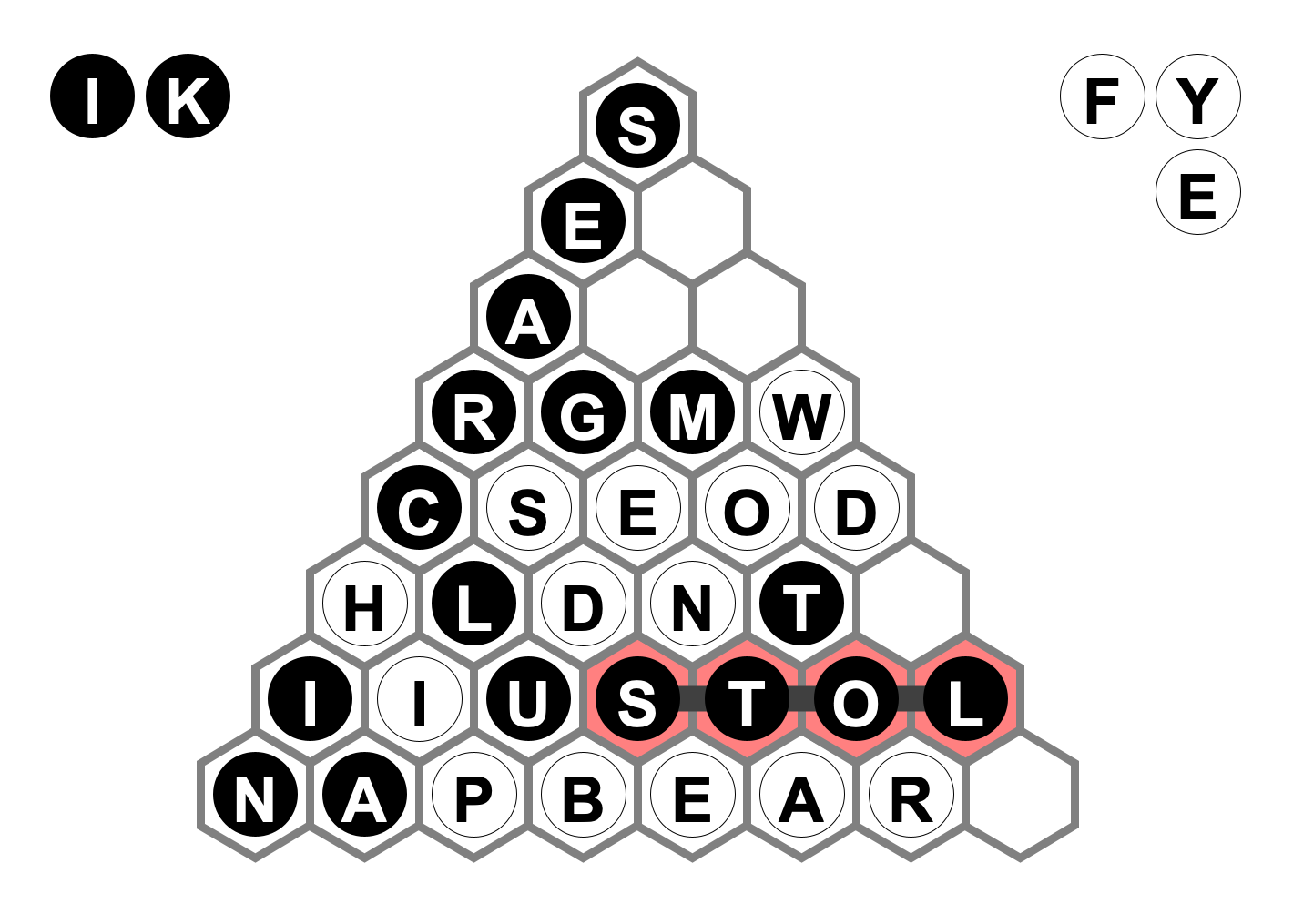
End of game
Play continues as long as a player’s group is not connected to all three sides of the board, and the opponent on his turn is unable to break it off. Note that the corners are considered to belong to the two adjacent sides.
White’s move FLED. After this move, black is not able to find the next move. Black gives up the game and White is the winner.
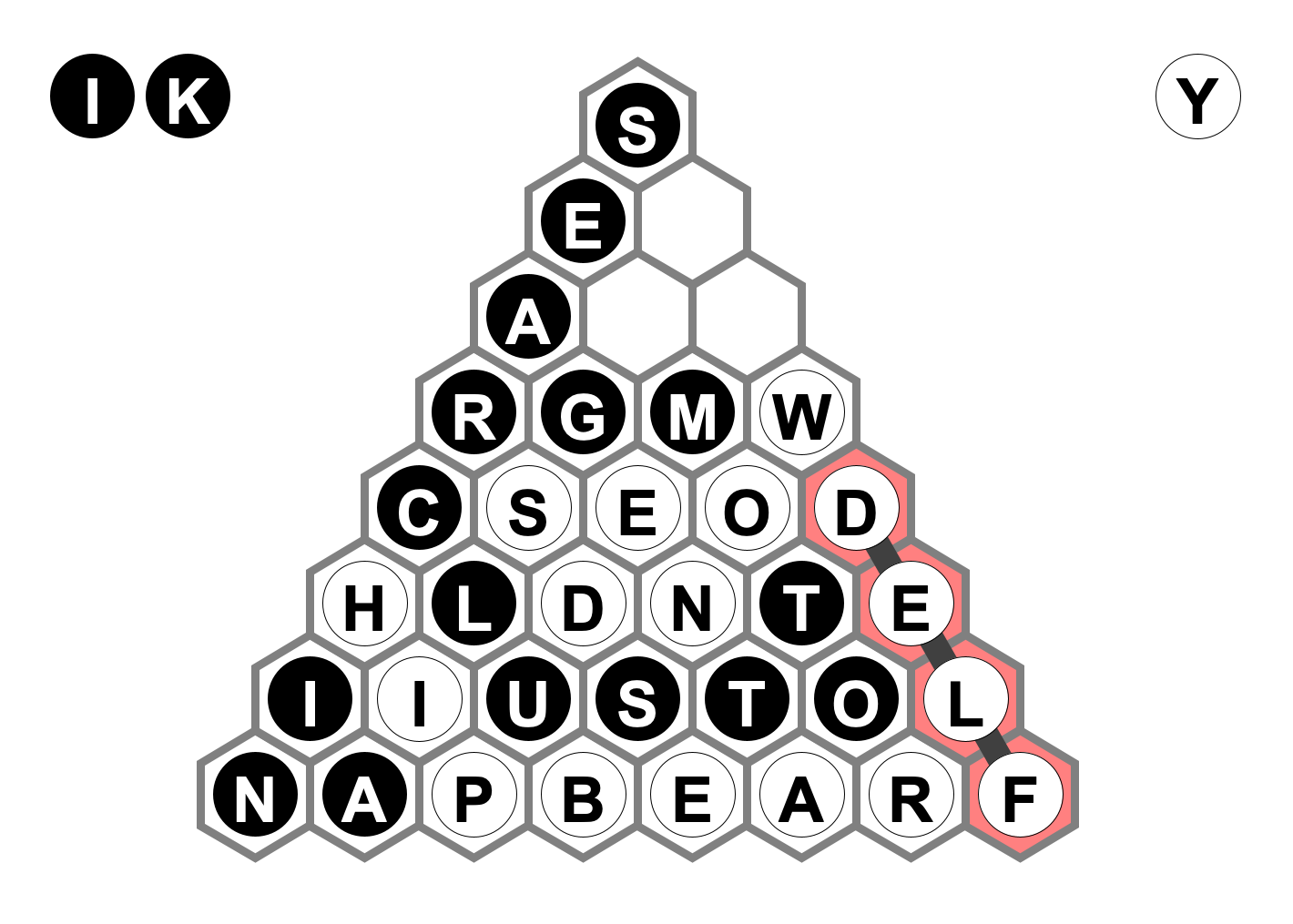
Variants on Little Golem
WYPS is played on Little Golem in multiple languages on sizes: 5,8,11 and 14.
There is also a numeric version where the letters are replaced by numbers. You must play even numbers or sequences of numbers.
Board sizes and letter distribution
WYPS can be played on any board sizes and in any language.
English
| Size | Rack size | Board size | Letters |
|---|---|---|---|
| 5 | 3 | 15 | ACDEEILMNO PRSTU |
| 6 | 4 | 21 | AABCDEEGHI LMNOPRSSTU Y |
| 7 | 4 | 28 | AABCDEEEFG HIIKLMNOOP RRSSTUWY |
| 8 | 5 | 36 | AAABCDDEEE EFGHIIIKLL MNNOOPRRSS STTUWY |
| 9 | 6 | 45 | AAAABCCDDE EEEEFGHIII KLLMNNNOOO PRRRSSSSTT UUVWY |
| 10 | 6 | 55 | AAAAABCCDD EEEEEEFGGH IIIIKLLLMM NNNOOOPPRR RRSSSSSTTT UUVWY |
| 11 | 7 | 66 | AAAAABBCCD DDEEEEEEEF GGHHIIIIIK LLLMMNNNNO OOOPPRRRRS SSSSSTTTTU UUVWYZ |
| 12 | 8 | 78 | AAAAAAABBC CCDDDEEEEE EEEEFGGHHI IIIIIKKLLL LMMNNNNOOO OOPPRRRRRS SSSSSSTTTT UUUVWYYZ |
| 13 | 9 | 91 | AAAAAAABBC CCDDDDEEEE EEEEEEFFGG GHHIIIIIIK KLLLLLMMMN NNNNOOOOOO PPPRRRRRRS SSSSSSSTTT TTUUUUVWYY Z |
| 14 | 9 | 105 | AAAAAAAABB BCCCCDDDDE EEEEEEEEEE EFFGGGHHHI IIIIIIIKKL LLLLLMMMNN NNNNOOOOOO PPPRRRRRRR SSSSSSSSSS TTTTTTUUUU VWYYZ |
German
| Size | Rack size | Board size | Letters |
|---|---|---|---|
| 5 | 3 | 15 | AEEGHIKLMN ORSTU |
| 6 | 4 | 21 | ABDEEEFGHI KLMNOPRSTT U |
| 7 | 4 | 28 | AABCDEEEEF GHIKLMNNOP RRSSTTUZ |
| 8 | 5 | 36 | AABCDEEEEE FGHIIKLLMN NNOPRRRSSS TTTUZÄ |
| 9 | 6 | 45 | AAABCDEEEE EEEFGGHHII KLLMNNNOOP RRRSSSTTTT UUWZÄ |
| 10 | 6 | 55 | AAABBCDEEE EEEEFGGHHI IIKKLLLMMN NNNOOPRRRR SSSSTTTTUU WZÄÖÜ |
| 11 | 7 | 66 | AAAABBCDDE EEEEEEEEFF GGHHIIIKKL LLMMNNNNNO OPPRRRRRSS SSSTTTTTUU VWZÄÖÜ |
| 12 | 8 | 78 | AAAAABBCCD DEEEEEEEEE EEFFGGGHHH IIIIKKLLLL MMNNNNNOOO PPRRRRRSSS SSSTTTTTTU UUVWZÄÖÜ |
| 13 | 9 | 91 | AAAAAABBBC CDDEEEEEEE EEEEEEEFFG GGHHHIIIIK KKLLLLLMMM NNNNNNOOOP PRRRRRRSSS SSSSTTTTTT TUUUUVWZÄÖ Ü |
| 14 | 9 | 105 | AAAAAAABBB CCDDDEEEEE EEEEEEEEEE EFFGGGGHHH HIIIIIKKKL LLLLMMMNNN NNNNNOOOPP RRRRRRRSSS SSSSSTTTTT TTTTUUUUVW ZZÄÖÜ |
Spain
| Size | Rack size | Board size | Letters |
|---|---|---|---|
| 5 | 3 | 15 | AACDEEILMN ORSTU |
| 6 | 4 | 21 | AAABCDEEGI LMNOOPRRST U |
| 7 | 4 | 28 | AAAAABCDEE EGIILMNOOO PRRSSTUV |
| 8 | 5 | 36 | AAAAAABCCD EEEEGIILLM NNOOOPRRRS SSTTUV |
| 9 | 6 | 45 | AAAAAAABCC DDEEEEEFGH IIIJLLMNNO OOOPRRRSSS TTUUV |
| 10 | 6 | 55 | AAAAAAAAAB CCDDEEEEEE FGHIIIIJLL LMMNNNOOOO PRRRRSSSST TUUVZ |
| 11 | 7 | 66 | AAAAAAAAAA ABBCCCDDDE EEEEEEFGHI IIIJLLLMMN NNOOOOOPPR RRRRSSSSST TTUUVZ |
| 12 | 8 | 78 | AAAAAAAAAA AAABBCCCDD DEEEEEEEEE FGGHIIIIIJ LLLLMMNNNN OOOOOOPPRR RRRRSSSSSS TTTUUUVZ |
| 13 | 9 | 91 | AAAAAAAAAA AAAAABBCCC CDDDDEEEEE EEEEEFGGHI IIIIIJLLLL MMMNNNNNOO OOOOOPPRRR RRRRSSSSSS STTTTUUUVZ Ñ |
| 14 | 9 | 105 | AAAAAAAAAA AAAAAAAABB CCCCDDDDEE EEEEEEEEEE FGGHIIIIII IJLLLLLMMM NNNNNNOOOO OOOOPPPRRR RRRRRRSSSS SSSSSTTTTU UUVZÑ |
French
| Size | Rack size | Board size | Letters |
|---|---|---|---|
| 5 | 3 | 15 | AACEEILMNO PRSTU |
| 6 | 4 | 21 | AABCDEEEGI ILMNOPRSST U |
| 7 | 4 | 28 | AAABCDEEEF GHIILMNOOP RRSSTTUV |
| 8 | 5 | 36 | AAAABCDEEE EEFGHIIILM NNOOPRRSSS TTUUVZ |
| 9 | 6 | 45 | AAAAABCCDE EEEEEFGHII IILLMNNOOO PRRRSSSSTT TUUVZ |
| 10 | 6 | 55 | AAAAAABCCD EEEEEEEEFG HIIIILLLMM NNNOOOPPRR RRSSSSSTTT UUUVZ |
| 11 | 7 | 66 | AAAAAAABBC CDDEEEEEEE EEFGGHIIII ILLLMMNNNO OOOPPRRRRR SSSSSSTTTT UUUVYZ |
| 12 | 8 | 78 | AAAAAAAAAB BCCCDDEEEE EEEEEEEFGG HIIIIIILLL LMMNNNNOOO OPPRRRRRRS SSSSSTTTTT UUUUVXYZ |
| 13 | 9 | 91 | AAAAAAAAAA BBCCCDDEEE EEEEEEEEEE FFGGHIIIII IILLLLMMNN NNNOOOOOPP PQRRRRRRRS SSSSSSSTTT TTTUUUUVXY Z |
| 14 | 9 | 105 | AAAAAAAAAA ABBCCCCDDD EEEEEEEEEE EEEEEFFGGH IIIIIIIILL LLLMMMNNNN NNOOOOOOPP PQRRRRRRRR SSSSSSSSST TTTTTTUUUU UVXYZ |
Italian
| Size | Rack size | Board size | Letters |
|---|---|---|---|
| 5 | 3 | 15 | AACEIILMNO PRSTU |
| 6 | 4 | 21 | AABCDEEGII LMNOOPRSTU V |
| 7 | 4 | 28 | AAABCDEEEF GIIILMNOOO PRRSTTUV |
| 8 | 5 | 36 | AAAABCCDEE EFGIIIILLM NNOOOPRRRS STTUVZ |
| 9 | 6 | 45 | AAAAAABCCD EEEEFGIIII IILLMNNNOO OOPRRRSSST TTUVZ |
| 10 | 6 | 55 | AAAAAAABCC CDDEEEEEFG IIIIIIILLM MNNNOOOOOP PRRRRSSSTT TUUVZ |
| 11 | 7 | 66 | AAAAAAAABC CCDDEEEEEE FGGIIIIIII ILLLMMNNNN OOOOOOPPRR RRRSSSSTTT TUUVVZ |
| 12 | 8 | 78 | AAAAAAAAAA BBCCCCDDEE EEEEEFGGHI IIIIIIIIIL LLMMNNNNOO OOOOOPPRRR RRRSSSSTTT TTUUUVVZ |
| 13 | 9 | 91 | AAAAAAAAAA ABBCCCCDDE EEEEEEEEFF GGHIIIIIII IIIILLLLMM MNNNNNOOOO OOOOPPPRRR RRRRSSSSST TTTTTUUUVV Z |
| 14 | 9 | 105 | AAAAAAAAAA AAABBCCCCC DDDEEEEEEE EEEFFGGGHI IIIIIIIIII IILLLLMMMN NNNNNOOOOO OOOOPPPRRR RRRRRSSSSS STTTTTTTUU UVVVZ |
Japanese
| Size | Rack size | Board size | Letters |
|---|---|---|---|
| 5 | 3 | 15 | いうかきくこさしたつ とはよりん |
| 6 | 4 | 21 | いうかきくけこさしせ たちつとはふやよりん ん |
| 7 | 4 | 28 | いいううおかきくけこ さししせたちつとはひ ふまやゆよりんん |
| 8 | 5 | 36 | いいううおかかきくけ こさししすせそたちつ てとなはひふほまみや ゆよりんんん |
| 9 | 6 | 45 | あいいいうううえおか かききくくけこさしし しすせそたちつてとな はひふほまみもやゆよ らりんんん |
| 10 | 6 | 55 | あいいいううううえお かかかききくくけこさ しししすせそたちつつ てとなにのはひふほま みめもやゆよよらりろ わんんんん |
| 11 | 7 | 66 | あいいいいううううう えおかかかきききくく くけここさししししす せせそたたちつつてと となにのはひふへほま みめもやゆよよらりろ わんんんんん |
| 12 | 8 | 78 | あいいいいいうううう ううえおかかかかきき きくくくけここささし ししししすせせそたた ちちつつつてととなに のははひふへほまみめ もやゆよよよらりりれ ろわんんんんんん |
| 13 | 9 | 91 | あいいいいいいううう ううううえおかかかか ききききくくくけけこ ここささしししししし すせせそたたちちつつ つてととなにねのはは ひふふへほまみむめも ややゆゆよよよらりり るれろわんんんんんん ん |
| 14 | 9 | 105 | あいいいいいいいうう うううううううえおか かかかかききききくく くくけけこここささし ししししししすせせそ たたたちちつつつつて てととなにねのははひ ひふふへほほまみむめ もややゆゆよよよよら りりるれろわんんんん んんんんん |
Dutch
| Size | Rack size | Board size | Letters |
|---|---|---|---|
| 5 | 3 | 15 | ADEEGIKLNO PRSTU |
| 6 | 4 | 21 | AABDEEEFGI KLMNOPRSTT U |
| 7 | 4 | 28 | AABDEEEEFG IIJKLMNNOO PRRSTTUW |
| 8 | 5 | 36 | AAABCDEEEE EFGHIIJKLL MNNOOPRRSS TTUVWZ |
| 9 | 6 | 45 | AAABCDDEEE EEEFGGHIII JKKLLMNNNO OOPRRRSSTT TUVWZ |
| 10 | 6 | 55 | AAAABCDDEE EEEEEEFGGH IIIJKKLLLM MNNNNOOOPP RRRSSSTTTT UUVWZ |
| 11 | 7 | 66 | AAAAABBCDD DEEEEEEEEE EFGGHIIIIJ KKKLLLMMNN NNOOOOPPRR RRSSSSTTTT TUUVWZ |
| 12 | 8 | 78 | AAAAAABBCD DDEEEEEEEE EEEEFFGGGH IIIIIJKKKL LLLMMNNNNN OOOOOPPPRR RRRSSSSTTT TTTUUVWZ |
| 13 | 9 | 91 | AAAAAAABBC DDDDEEEEEE EEEEEEEEFF GGGHIIIIIJ KKKLLLLLMM MNNNNNNOOO OOOPPPRRRR RRSSSSSTTT TTTTUUUVVW Z |
| 14 | 9 | 105 | AAAAAAAABB CDDDDEEEEE EEEEEEEEEE EFFGGGGHHI IIIIIJJKKK KLLLLLMMMN NNNNNNOOOO OOOPPPRRRR RRRSSSSSST TTTTTTTUUU VVWWZ |
Polish
| Size | Rack size | Board size | Letters |
|---|---|---|---|
| 5 | 3 | 15 | AEIKLMNORS TUWYZ |
| 6 | 4 | 21 | AABCDEIKLM NOPRSTUWYZ Ł |
| 7 | 4 | 28 | AABCDEEGII JKLMNOOPRS TUWYZĄĘŁ |
| 8 | 5 | 36 | AAABCDEEGH IIJKKLMMNN OOOPRRSTUW YZĄĘŁŻ |
| 9 | 6 | 45 | AAAABCCDEE EGHIIIJKKL MMNNOOOPRR SSTUUWWYYZ ZĄĘŁŻ |
| 10 | 6 | 55 | AAAAABCCDE EEFGHIIIIJ KKKLLMMNNO OOOPPRRRSS TTUUWWYYZZ ÓĄĘŁŻ |
| 11 | 7 | 66 | AAAAAABCCD DEEEEFGHII IIJKKKLLMM MNNNOOOOOP PRRRSSSTTU UUWWYYYZZÓ ĄĘŁŁŚŻ |
| 12 | 8 | 78 | AAAAAAABBC CCDDEEEEFG HIIIIIJJKK KLLLMMMNNN OOOOOOPPRR RRSSSTTUUU WWWYYYZZZÓ ĄĄĆĘŁŁŚŻ |
| 13 | 9 | 91 | AAAAAAAAAB BCCCDDEEEE EFGGHIIIII IJJKKKKLLL MMMMNNNNOO OOOOOPPPRR RRSSSTTTUU UUWWWYYYYZ ZZÓĄĄĆĘŁŁŚ Ż |
| 14 | 9 | 105 | AAAAAAAAAA BBCCCCDDDE EEEEEFGGHI IIIIIIJJKK KKKLLLMMMM NNNNNOOOOO OOOPPPRRRR RSSSSTTTUU UUWWWWYYYY ZZZZÓĄĄĆĘŁ ŁŁŃŚŻ |
Russian
| Size | Rack size | Board size | Letters |
|---|---|---|---|
| 5 | 3 | 15 | АВЕИКЛМНОП РСТУЯ |
| 6 | 4 | 21 | ААБВДЕИКЛМ НООПРСТУЫЮ Я |
| 7 | 4 | 28 | ААБВГДЕЕЗИ ИКЛМНООПРС ТУХЧШЫЮЯ |
| 8 | 5 | 36 | АААБВГДЕЕЗ ИИЙКЛЛМННО ООПРРСТТУХ ЧШЫЬЮЯ |
| 9 | 6 | 45 | ААААБВВГДЕ ЕЕЖЗИИИЙКК ЛЛММННОООП РРССТТУУХЧ ШЫЬЮЯ |
| 10 | 6 | 55 | АААААБВВГД ЕЕЕЕЖЗИИИЙ ККЛЛЛММННН ООООППРРРС СТТТУУХЧШЩ ЫЬЮЯЁ |
| 11 | 7 | 66 | АААААБВВГД ДЕЕЕЕЕЖЗИИ ИИЙКККЛЛЛМ ММНННООООО ППРРРСССТТ ТУУУХЦЧШЩЫ ЫЬЮЯЯЁ |
| 12 | 8 | 78 | АААААААББВ ВВГДДЕЕЕЕЕ ЖЗЗИИИИИЙК ККЛЛЛЛМММН НННООООООП ПРРРРСССТТ ТТУУУУХЦЧШ ЩЫЫЬЮЯЯЁ |
| 13 | 9 | 91 | ААААААААББ ВВВГДДЕЕЕЕ ЕЕЖЗЗИИИИИ ИЙККККЛЛЛЛ ММММНННННО ООООООПППР РРРССССТТТ ТТУУУУФХХЦ ЧШЩЫЫЬЮЮЯЯ Ё |
| 14 | 9 | 105 | АААААААААБ БВВВВГГДДЕ ЕЕЕЕЕЕЖЗЗИ ИИИИИИЙЙКК ККЛЛЛЛЛМММ МННННННООО ООООООПППР РРРРССССТТ ТТТУУУУФХХ ЦЧЧШШЩЫЫЬЮ ЮЯЯЯЁ |
Greek
| Size | Rack size | Board size | Letters |
|---|---|---|---|
| 5 | 3 | 15 | ΑΑΕΗΙΚΛΜΝΟ ΡΣΤΥΩ |
| 6 | 4 | 21 | ΑΑΓΕΕΗΙΙΚΛ ΜΝΟΟΠΡΣΣΤΥ Ω |
| 7 | 4 | 28 | ΑΑΑΒΓΔΕΕΗΘ ΙΙΚΛΜΝΝΟΟΠ ΡΣΣΤΥΦΧΩ |
| 8 | 5 | 36 | ΑΑΑΑΒΓΔΕΕΕ ΗΘΙΙΙΚΛΜΝΝ ΟΟΟΠΡΡΣΣΣΤ ΤΥΥΦΧΩ |
| 9 | 6 | 45 | ΑΑΑΑΑΒΓΔΕΕ ΕΕΖΗΗΘΙΙΙΙ ΚΚΛΛΜΝΝΞΟΟ ΟΠΡΡΣΣΣΤΤΥ ΥΦΧΩΩ |
| 10 | 6 | 55 | ΑΑΑΑΑΑΒΓΔΕ ΕΕΕΕΖΗΗΘΙΙ ΙΙΚΚΛΛΜΜΝΝ ΝΞΟΟΟΟΠΠΡΡ ΡΣΣΣΣΤΤΤΥΥ ΥΦΧΩΩ |
| 11 | 7 | 66 | ΑΑΑΑΑΑΑΑΒΓ ΔΕΕΕΕΕΕΖΗΗ ΗΘΙΙΙΙΙΚΚΚ ΛΛΜΜΝΝΝΝΞΟ ΟΟΟΟΠΠΡΡΡΣ ΣΣΣΣΤΤΤΥΥΥ ΦΧΨΩΩΩ |
| 12 | 8 | 78 | ΑΑΑΑΑΑΑΑΑΒ ΓΓΔΔΕΕΕΕΕΕ ΕΖΗΗΗΘΙΙΙΙ ΙΙΚΚΚΛΛΛΜΜ ΜΝΝΝΝΞΟΟΟΟ ΟΟΠΠΡΡΡΡΣΣ ΣΣΣΣΤΤΤΤΥΥ ΥΥΦΧΨΩΩΩ |
| 13 | 9 | 91 | ΑΑΑΑΑΑΑΑΑΑ ΒΓΓΔΔΕΕΕΕΕ ΕΕΕΖΗΗΗΘΙΙ ΙΙΙΙΙΚΚΚΚΛ ΛΛΜΜΜΝΝΝΝΝ ΞΟΟΟΟΟΟΟΠΠ ΠΡΡΡΡΡΣΣΣΣ ΣΣΣΤΤΤΤΤΥΥ ΥΥΦΦΧΧΨΩΩΩ Ω |
| 14 | 9 | 105 | ΑΑΑΑΑΑΑΑΑΑ ΑΑΒΓΓΔΔΕΕΕ ΕΕΕΕΕΕΖΗΗΗ ΗΘΙΙΙΙΙΙΙΙ ΙΚΚΚΚΛΛΛΛΜ ΜΜΜΝΝΝΝΝΝΞ ΟΟΟΟΟΟΟΟΟΠ ΠΠΡΡΡΡΡΣΣΣ ΣΣΣΣΣΤΤΤΤΤ ΤΥΥΥΥΥΦΦΧΧ ΨΩΩΩΩ |
Czech
| Size | Rack size | Board size | Letters |
|---|---|---|---|
| 5 | 3 | 15 | ADEIKLMNOP RSTUV |
| 6 | 4 | 21 | ABDEHIKLMN OPRSTUVYZÁ Í |
| 7 | 4 | 28 | AABCDEEHIJ KLMNNOOPRS TUVYZÁÍŠ |
| 8 | 5 | 36 | AABCDEEEHI IJKLLMNNOO PRSTTUUVYZ ÁÍČĚŘŠ |
| 9 | 6 | 45 | AAABCDEEEH IIJKKLLMMN NNOOOPRRST TUUVVYZÁÉÍ ÝČĚŘŠ |
| 10 | 6 | 55 | AAAABCDDEE EEHIIJKKLL LMMNNNOOOO PPRRSSTTUU VVYZÁÁÉÍÍÝ ČĚŘŠŽ |
| 11 | 7 | 66 | AAAABCDDEE EEEHIIIJKK KLLLMMNNNN OOOOPPRRRS STTTUUUVVV YYZZÁÁÉÍÍÝ ČĚŘŠŮŽ |
| 12 | 8 | 78 | AAAAABCDDE EEEEFGHHII IJKKKLLLLM MMNNNNNOOO OOPPPRRRSS STTTTUUUUV VVYYZZÁÁÉÍ ÍÝČĚŘŠŮŽ |
| 13 | 9 | 91 | AAAAAABBCC DDDEEEEEEF GHHIIIIJJK KKLLLLLMMM NNNNNOOOOO OPPPRRRRSS STTTTUUUUV VVVYYZZÁÁÁ ÉÍÍÍÝČĚŘŠŮ Ž |
| 14 | 9 | 105 | AAAAAAABBC CDDDEEEEEE EEFGHHIIII IJJKKKKLLL LLMMMMNNNN NNNNOOOOOO OPPPRRRRSS SSTTTTTUUU UUVVVVYYZZ ÁÁÁÉÍÍÍÝČĚ ŘŠŠŮŽ |
Slovak
| Size | Rack size | Board size | Letters |
|---|---|---|---|
| 5 | 3 | 15 | ADEIKLMNOP RSTUV |
| 6 | 4 | 21 | ABCDEHIKLM NOPRSTUVZÁ Í |
| 7 | 4 | 28 | AABCDEEHIK LMNOOPRSTU VYZÁÍÚČŠ |
| 8 | 5 | 36 | AAABCDEEHI IJKKLLMMNN OOPRRSTUVY ZÁÍÚČŠ |
| 9 | 6 | 45 | AAABCDEEEH IIIJKKLLMM NNOOOPRRST TUUVVYZÁÍÚ ÝČŠŤŽ |
| 10 | 6 | 55 | AAAABCDDEE EEHIIIJKKL LLMMNNNOOO OPPRRRSSTT UUVVYZÁÁÍÚ ÝČŠŤŽ |
| 11 | 7 | 66 | AAAAABCDDE EEEEFGHIII IJKKKLLLMM MNNNOOOOPP RRRSSTTTUU UVVVYZÁÁÉÍ ÚÝČŠŤŽ |
| 12 | 8 | 78 | AAAAAABBCC DDEEEEEEFG HHIIIIJKKK LLLLMMMNNN NOOOOOPPRR RRSSTTTUUU VVVYZZÁÁÉÍ ÍÚÝČĽŠŤŽ |
| 13 | 9 | 91 | AAAAAAABBC CDDDEEEEEE FGHHIIIIIJ JKKKKLLLLM MMMNNNNNOO OOOOPPPRRR RSSSTTTUUU VVVYZZÁÁÉÍ ÍÚÚÝČČĽŠŠŤ Ž |
| 14 | 9 | 105 | AAAAAAAABB CCDDDEEEEE EEEFGHHIII IIIJJKKKKL LLLLMMMMNN NNNNOOOOOO OOPPPRRRRR SSSTTTTUUU UVVVVYYZZÁ ÁÁÉÍÍÚÚÝČČ ĽŠŠŤŽ |
WYPS for 4 players
The 4-player variant is a lot of fun. Players play together in pairs. Each of the four players has as many stones as in a two-player game. This means that, for example, on a board of size 8, each player has 5 stones. The start of the game is similar to a 2-player game. Players randomly select 4 sets of stones and players sequentially choose their set of stones in a counterclockwise order. The player who picked the stones last starts the game.
In a 4-player game, the Atari rule does not apply. This means that the connection does not have to be broken immediately. If one of the players no longer has stones, the game continues and that player passes their turn.
Important rule: players can talk out loud during the game and can analyze their moves together !
The game is very challenging because the end phase of the game when there are no more stones in the bag occurs very early.
35 - XiangQi
Chinese chess.
XiangQi, also known as Chinese chess, is played on the intersections of a 9x10 board. Red moves first.
Goal
The goal is to checkmate the opponent’s general. A player may not make a move that leaves their own general in check.
Board
Each player has a 3x3 palace. The general and advisors may not leave the palace.
The river divides the two sides of the board. Elephants cannot cross the river. Soldiers gain sideways movement after crossing it.
Pieces
| Piece | Symbol | Movement |
|---|---|---|
| General | K | One point orthogonally inside the palace. The two generals may not face each other on the same file with no piece between them. |
| Advisor | A | One point diagonally inside the palace. |
| Elephant | B | Exactly two points diagonally. It cannot jump over a blocking piece and cannot cross the river. |
| Horse | N | One point orthogonally, then one point diagonally outward. It cannot move in a direction where the first orthogonal point is occupied. |
| Chariot | R | Any number of clear points orthogonally. |
| Cannon | C | Moves like a chariot when not capturing. To capture, it must jump exactly one piece of either color, then land on an enemy piece. |
| Soldier | P | One point forward. After crossing the river, it may also move one point sideways. It never moves backward. |
Pieces do not promote in XiangQi.
Variant on Little Golem
Little Golem currently supports the standard XiangQi variant.