Go
Rules
The playing pieces are called stones. Black moves first, then players alternate placing one stone on an empty intersection. Stones do not move after placement.
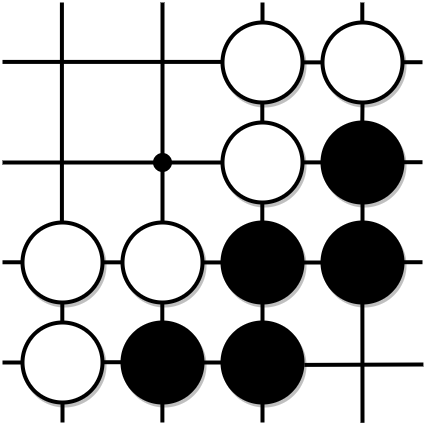
Adjacent stones of the same color form a group. Empty intersections adjacent orthogonally to a group are its liberties. If a move removes the last liberty of one or more opponent groups, those stones are captured and removed from the board. A move that would leave the played stone or its group with no liberties is illegal unless it captures opposing stones at the same time.
The ko rule forbids immediately recreating the previous board position by recapturing a single stone. A player may pass. Two passes start scoring.
For square-board Go variants on Little Golem, scoring is handled by a score proposal. Hexagonal Go uses the separate agreement process described below.
- After two passes, a player marks dead stones and sends a
scoremove. - The opponent may accept the proposal with
accept. - The score counts territory plus captured prisoners, with komi added for White.
- A player may also resign.
Go has simple rules but is extremely complex.
Rules of Go on Wikipedia.
Variants on Little Golem
Sizes 9x9, 13x13, 19x19, 27x27, 37x37
There are five square-board sizes with ordinary edges. The standard game is 19x19. These sizes use komi 6.5 unless the game setup explicitly stores another komi value.
Hahn Pointing System
The Hahn Pointing System is a new method to determine the tournament winner using points earned as a result of each game in place of the players win/loss record. Professor Sang-Dae Hahn of Myongji University developed the system to foster aggressive, fighting games with an emphasis on reading.
The Hahn system is based upon the scoring used in bangneki. Points are awarded to the winner and the loser of the game based upon the result. A single game is worth 100 points. The 100 points are divided between the winner and the loser based upon the difference in count at the end of the game.
A difference of 0.5 to 10 in the count results in the winner receiving 60 points and the loser receiving 40 points.
A difference of 10.5 to 20 in the count results in the winner receiving 70 points and the loser receiving 30 points.
A difference of 20.5 to 30 in the count results in the winner receiving 80 points and the loser receiving 20 points.
A difference of 30.5 to 40 in the count results in the winner receiving 90 points and the loser receiving 10 points.
A difference of more than 40 points results in the winner receiving all 100 points and the loser receiving no points.
The tournament winner in a Hahn pointing system scored tournament is the player with the most points, regardless of the player’s win/loss record in the tournament. Therefore, a player with 580 points and a win/loss record of 5-2 beats a player with 570 points and a perfect win/losss record of 7-0.
Random board
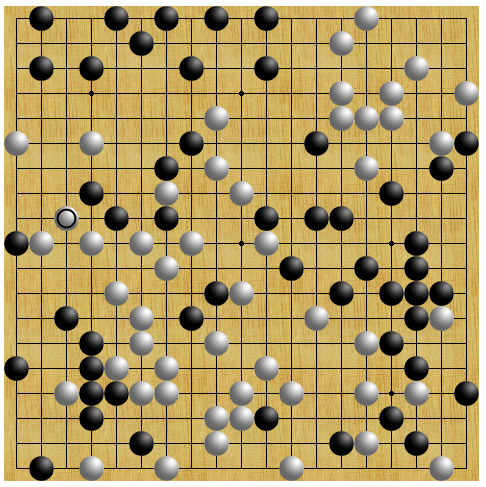
Players play from a position, where there are already 100 stones on the board. The positions have been checked for equality by the computer.
Toroidal Go: 11x11 and 17x17
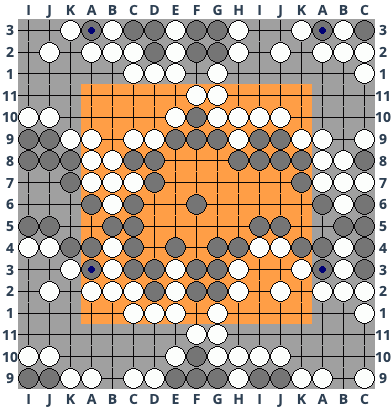
Toroidal Go is played on an 11x11 or 17x17 board with wrap-around edges. The top edge is adjacent to the bottom edge, and the left edge is adjacent to the right edge. Each intersection still has four neighbours, but there are no corners or true edges. Connections, liberties, captures and territory continue across the opposite sides of the board.
| Board | Intersections | Komi for White |
|---|---|---|
| 11x11 | 121 | 4.5 |
| 17x17 | 289 | 5.5 |
The larger board is a separate variant; existing 11x11 games keep their rules. Komi is fixed by each game’s setup. Both sizes use the square-board Go scoring proposal and acceptance process described above.
The app repeats strips of the board around the central playing area to show connections across the edges. These are copies of the same intersections, not extra playing spaces. On the 17x17 board, nine star points at the intersections of lines 4, 9 and 14 help with orientation.

Hexagonal Go (HexGo)
HexGo uses a hexagonal board with eight intersections along each side and 169 intersections in total. An interior intersection has six neighbours instead of four. Groups, liberties and captures follow these six directions; the board does not wrap around.
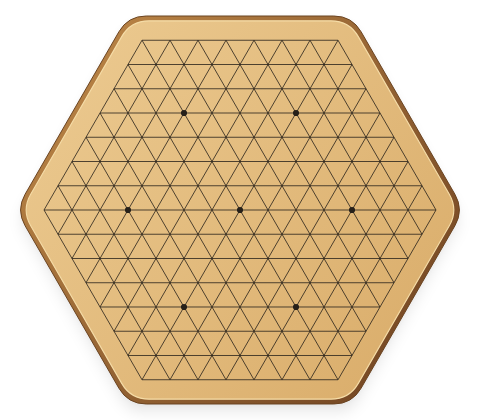
The HexGo board in the app. The dark star points are orientation marks, not stones.
Black plays first and players alternate placing one stone. A move removes opponent groups with no liberties before checking the played group’s liberties. Suicide is forbidden. Positional superko forbids a placement that recreates any earlier board position, not only the immediately previous position. Players may also resign.
HexGo uses Chinese area scoring: count each player’s stones on the board plus empty intersections surrounded by that player. Captured prisoners do not add separate points. White receives komi, normally 5.5, fixed by the game’s setup.
To finish a game, both players must agree to the same score:
- Choose PASS to preview a score proposal. The board shows ownership and marks stones assessed as dead with crosses. Opening this preview does not submit a move or accept the score.
- If you agree, use Send to submit the pass and its score proposal.
- The opponent can choose PASS, review the same proposal, and use Send to accept it. This second consecutive pass ends the game with that score.
- If either player disagrees, continue playing stones. A placement cancels the pending agreement; a later pass will propose a score for the new position.
The score preview is an estimate of life and death, not a forced adjudication. Check it before accepting, and continue play when a group or disputed area needs to be resolved. The opponent accepts the exact proposal already submitted; it is not recalculated between the two passes.
Links
- Wikipedia
- SenSei Library - site with 23000 pages about Go
- Go Books on iPad
Feedback
Was this page helpful?
Glad to hear it! Please tell us how we can improve.
Sorry to hear that. Please tell us how we can improve.